
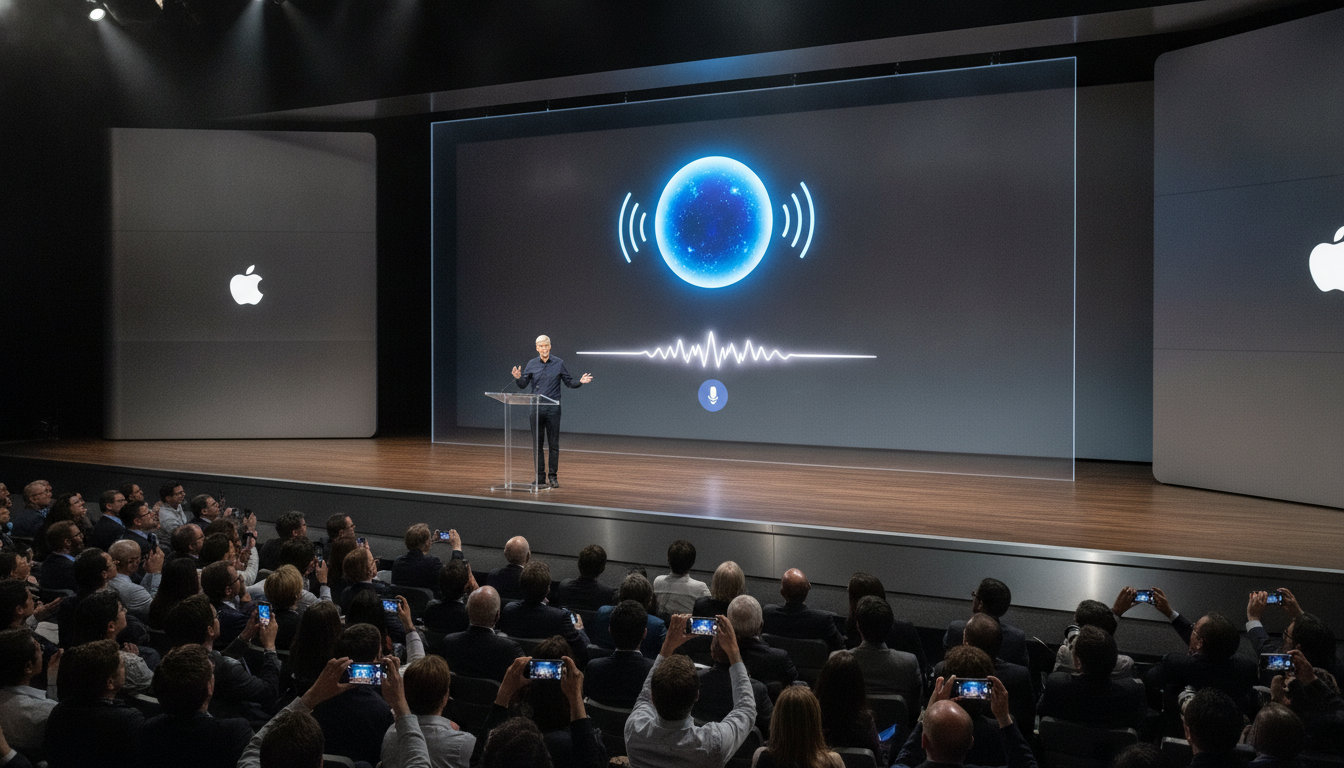
Apple unveils Siri AI at WWDC with standalone app and privacy-first features
Apple reveals Siri AI at WWDC with enhanced speech recognition, a standalone app and privacy-first features. Initial rollout excludes the EU and will not launch in China.
Apple used its annual WWDC keynote in Cupertino to unveil “Siri AI,” a major overhaul of its voice assistant that combines improved speech recognition, deeper app integration and new privacy-centered design principles. The company said Siri AI will be available as a standalone app on iPhone, iPad and Mac, and will begin in English with additional languages to follow. Apple framed the move as part of a broader “Apple Intelligence” strategy to embed generative and contextual AI across its ecosystem without compromising user privacy.
WWDC reveal and product scope
Apple introduced Siri AI during its Worldwide Developers Conference, positioning the update as the most significant evolution of Siri in years. The company highlighted a more expressive voice, faster and more accurate speech recognition, and the ability for Siri to reference earlier conversations to provide context-aware responses. Senior Apple executives said the assistant will be deeply linked to users’ apps and personal context to deliver more useful, task-oriented assistance.
Apple also said Siri AI will run in a new standalone application that stores images and search interactions, and that it will be compatible with the company’s cloud computing infrastructure. The firm signalled that rollout will begin on iPhone and iPad, extend to Mac computers, and that work is ongoing to bring the experience to the Apple Watch.
Privacy and Apple Intelligence vision
Apple framed Siri AI as part of “Apple Intelligence,” a platform-level approach that embeds generative AI across devices while keeping user data protected. Craig Federighi, Apple’s software chief, described the company’s aim to make AI “focus on you and your needs” by integrating context from personal apps and respecting privacy at every step. Apple emphasized on-device processing where feasible and said the new assistant will link securely to apps to retrieve relevant information only with appropriate safeguards.
The company underscored that search queries and images processed by Siri AI will be stored in a dedicated app, designed to give users control and transparency over their interactions. Apple stressed that this architecture is intended to balance the capabilities of generative AI with its longstanding privacy commitments.
Regional rollout and regulatory limitations
Apple cautioned that Siri AI will not be available immediately in all markets. The company said the service will be unavailable “initially” on iPhone and iPad in the European Union while it completes regulatory steps, and that it will not launch in China at this stage. Apple attributed those restrictions to pending approvals and local compliance requirements, and said it will expand availability once approvals are secured.
The staggered regional rollout creates a phased global release that will depend on regulatory clearances and language support expansions. Apple has committed to bringing additional languages to Siri AI “quickly,” but did not provide a detailed timetable for EU or China availability during the announcement.
Technical compatibility and system updates
Apple confirmed that the new features will arrive alongside a range of system updates, including iOS 27 and the next macOS release, named “Golden Gate.” The company said iOS 27 will support devices back to the iPhone 11, while Golden Gate will introduce complementary desktop-level enhancements for the Siri AI experience. Siri AI will be designed to interoperate with Apple’s cloud computing services for more compute-intensive tasks while keeping sensitive data under user control.
Apple also explained that some functionality will depend on device capabilities, and that features such as the more expressive Siri voice may roll out incrementally across hardware classes. The firm reiterated that it continues to refine the watchOS integration for smartwatches.
Expanded child-safety and parental-control tools
Alongside Siri AI, Apple announced a suite of updates aimed at child safety and parental controls. New settings will allow parents to automatically restrict their children to approved apps and require permission for access to any new website via a “Request to Browse” feature. Apple said these controls are intended to simplify parental supervision of online activity without wholly blocking access to educational or age-appropriate content.
Apple also revealed enhancements to image-handling safeguards, including automatic blurring of violent images in messaging apps and notifications to parents when such content is detected. The company said it is working with the American Academy of Pediatrics to develop a guide for families on healthy digital habits and responsible device use.
Market context and competitive pressure
Observers noted that Siri AI represents an effort by Apple to close the gap with competitors that have moved aggressively to integrate generative AI into everyday computing tasks. Firms such as Microsoft and Google have already introduced advanced conversational assistants and multi-modal AI features, and Apple’s announcement signals its intent to match those capabilities while emphasising privacy and integration with its device ecosystem.
Apple’s emphasis on a standalone app, broader contextual access and privacy protections may appeal to users who have been cautious about handing data to third-party AI services. How quickly Apple can navigate regulatory hurdles in major markets and expand language support will likely determine the initial commercial impact of Siri AI.
Apple said Siri AI will begin rolling out in English first, with other languages to be added rapidly, and that more detailed launch dates will follow as regional approvals are completed. The company’s approach links improved assistant capabilities to its broader software updates, making the voice assistant a central element of its product roadmap for the year.
The announcement marks a pivotal step in Apple’s AI strategy, blending advanced conversational abilities with tighter integration across devices and a continued emphasis on user privacy.
