
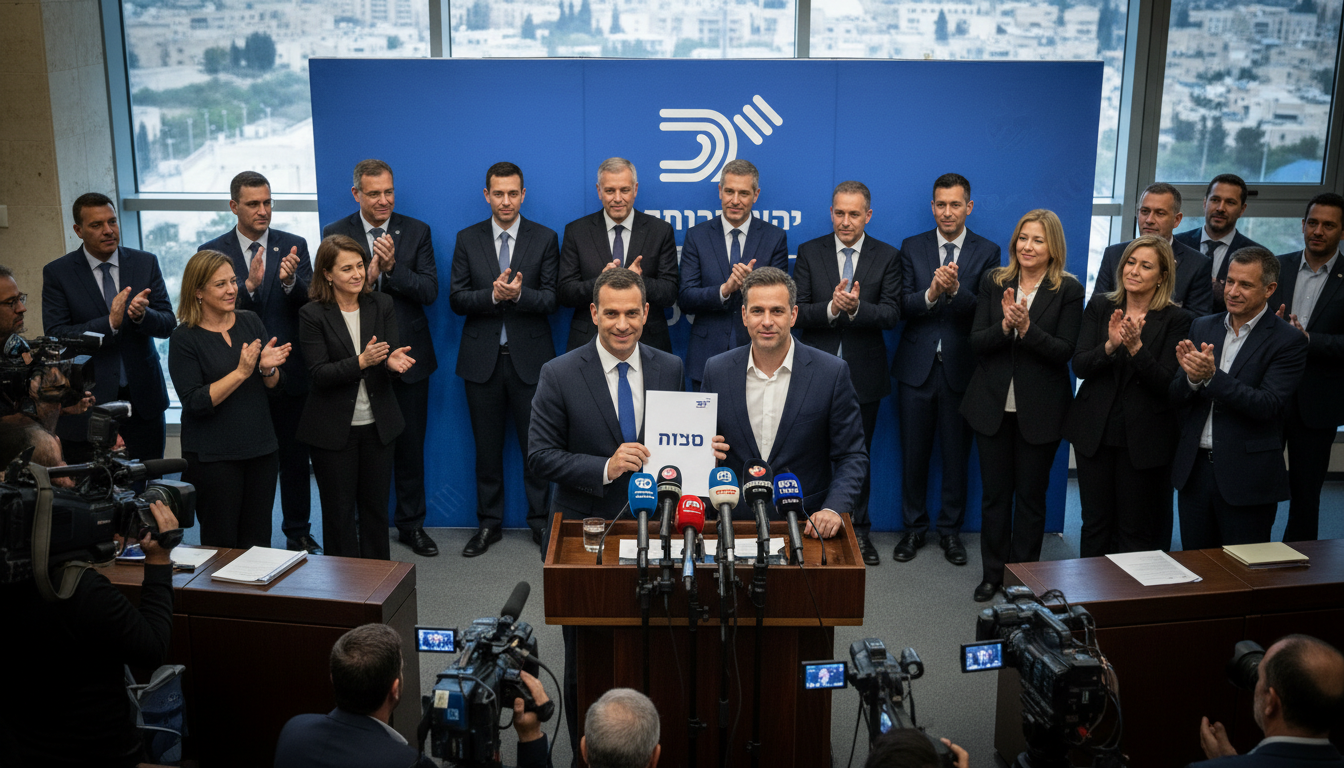
Bennett-Lapid merger creates ‘Biyahad’ party with Naftali Bennett as leader
Naftali Bennett and Yair Lapid announce a Bennett-Lapid merger to form ‘Biyahad’, uniting centrist forces with a joint platform for Israel’s next election.
Bennett-Lapid merger announced
Naftali Bennett and Yair Lapid revealed on Sunday that they have merged their parties into a single political formation to contest the upcoming Israeli election. The Bennett-Lapid merger brings together Bennett’s new list and Lapid’s Yesh Atid under the name “Biyahad” — Hebrew for “Together” — with Bennett as the party leader. The move was presented as the start of a broader “reform bloc” intended to end internal fragmentation and consolidate the anti-Netanyahu vote.
The pair held a joint press conference where they described the merger as a strategic decision based on recent polling and repeated meetings over the previous week. Officials close to both leaders said the agreement was finalized overnight and signed by both men, marking a formal end to separate centrist campaigns ahead of the election.
New party structure and leadership balance
Under the merger agreement, Bennett will hold the leadership of the combined party and his slate will have majority representation in the new internal composition. Yesh Atid members and Bennett’s supporters are to be integrated into a single organizational structure aimed at broader outreach across centrist and liberal constituencies. The new party’s name, “Biyahad,” signals an emphasis on unity across the political center.
Sources indicate the arrangement includes negotiations over candidate lists, internal governing rules, and a shared campaign platform. The consolidation aims to present a single alternative to the incumbent coalition, streamline fundraising and campaigning, and reduce vote splitting that analysts say has weakened opposition efforts in previous cycles.
Policy pledges shaping the joint platform
Bennett and Lapid outlined a series of policy commitments they say will form the backbone of the Bennett-Lapid merger platform. Central pledges include the immediate establishment of an official inquiry into the events of October 7, 2023, a headline issue for families and broader public accountability. The party also pledged to advance legislation for universal military conscription, including measures to integrate the Haredi community, and to condition state funding for religious institutions that resist the draft.
Other stated priorities are setting an eight-year limit for the prime minister’s term, reinforcing sovereignty over Israel’s territory, and promoting a form of Jewish identity described as inclusive rather than coercive. Party spokespeople said these measures are designed to appeal to voters concerned about national security, civic equality, and the rule of law.
Security and accountability commitments
Bennett stated that, if elected, his government would form a formal commission on day one to investigate the failures that led to the October 7 attacks, a pledge intended to respond to public demands for transparency. The commitment to a high-profile probe is intended to provide answers to bereaved families and to restore public confidence in military and civilian preparedness. Analysts say the promise aims to neutralize criticism that centrist leaders have been less assertive on security.
The new party framed these security commitments alongside assurances that it will “not cede an inch” of territory to Israel’s adversaries. By pairing accountability with a strong security posture, Bennett and Lapid seek to position Biyahad as both rigorous on defence and committed to institutional reform.
Political reactions and opposition criticism
The merger drew immediate criticism from Prime Minister Benjamin Netanyahu’s Likud party and its nationalist allies, who accused Bennett of shifting positions and attacked the union as opportunistic. The Religious Zionism party and hardline figures, including Itamar Ben-Gvir, dismissed the alliance and sought to paint Bennett as ideologically unreliable. Senior opposition figures in the current government characterized the move as a tactical attempt to consolidate centrist votes rather than a durable political realignment.
Conversely, several centrist and security-minded figures offered measured endorsements. Former Chief of Staff Gadi Eizenkot, who was approached earlier about joining Bennett’s list and declined, issued statements congratulating the leaders and describing the partnership as a potential boon for electoral victory. Avigdor Lieberman and other centrist party heads welcomed the move as strengthening the broader anti-Netanyahu camp.
Electoral strategy and coalition math
Bennett and Lapid cited polling and repeated strategy sessions as the triggers for their decision to unite, saying internal divisions were undermining the opposition’s chances. The merger is intended to expand the centrist base, attract undecided voters, and create clearer coalition arithmetic ahead of the ballot. Campaign strategists within the new party will now focus on maximizing turnout across urban, secular, and moderate religious constituencies.
Party officials signalled plans for an aggressive outreach campaign, including targeted messaging on security, judicial reform, and social cohesion. They also indicated readiness to negotiate with other centrist and left-leaning parties to build a post-election governing majority capable of enacting the promised reforms.
The consolidation of Bennett and Lapid into a single ticket marks a notable reshaping of Israel’s political landscape ahead of the election, with implications for coalition negotiations and campaign dynamics. Supporters argue the Bennett-Lapid merger is a pragmatic response to current fractures, while critics see it as an electoral calculation that will now be tested at the polls.
Public reaction in the coming weeks will be decisive, as voters and allied parties weigh whether Biyahad can translate unity into a stable governing alternative and deliver on the accountability and security commitments that motivated the union.
