
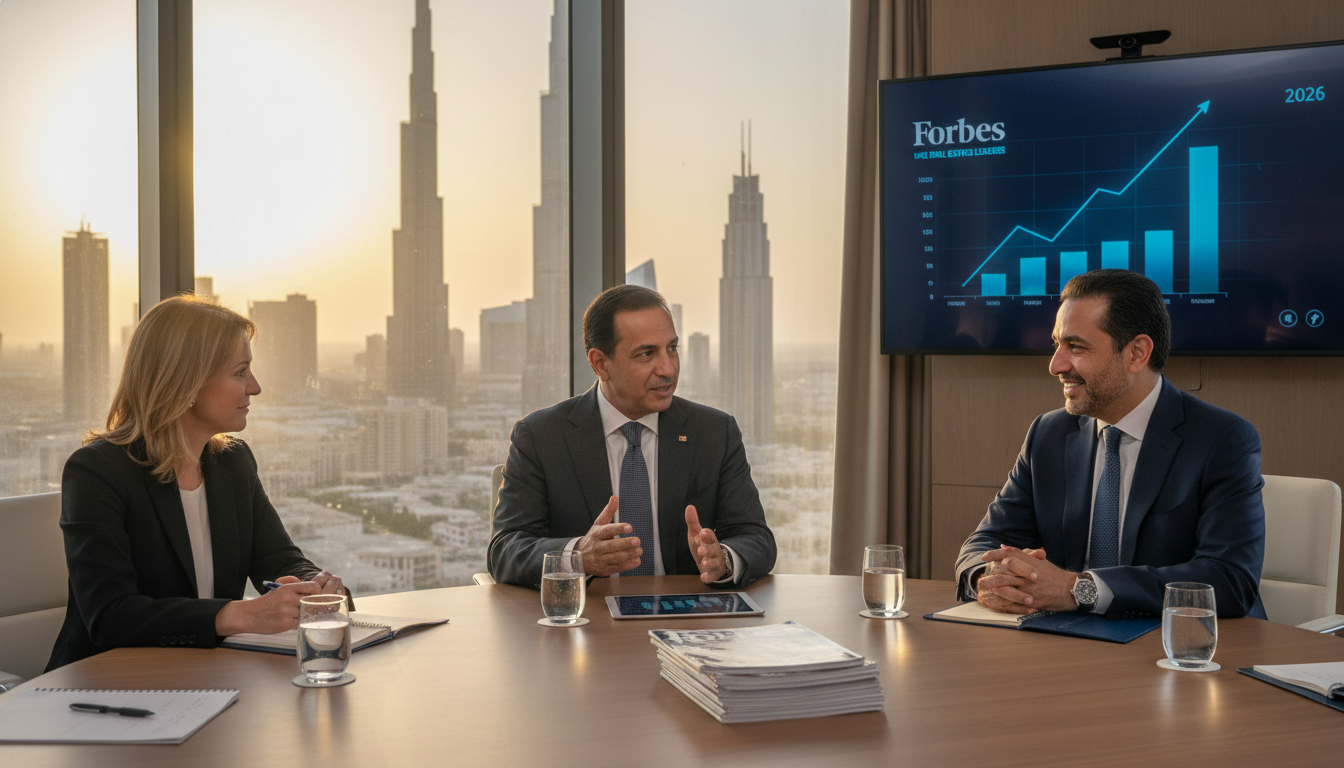
Forbes Middle East real estate leaders 2026: UAE executives dominate regional ranking
Forbes Middle East names 2026’s most influential real estate leaders; UAE claims 47 spots, Sajwani tops the list and billionaires hold $39.4bn combined.
Forbes Middle East announces 2026 ranking of real estate leaders
Forbes Middle East has released its 2026 list of the region’s most influential real estate leaders, compiled over several months using a set of quantitative and qualitative measures. The list evaluates executives on factors including years of experience, the value of completed and ongoing projects, company financials such as total assets and revenues when available, land portfolio size, and number of residential units owned by their firms. The ranking underscores the continued prominence of major developers across the Gulf and North Africa as central players in regional property markets.
Methodology and criteria used by Forbes Middle East
Forbes Middle East said the compilation relied on multiple data points to produce a balanced ranking of influence rather than pure wealth or media profile. Analysts reviewed companies’ project pipelines and financial disclosures, and adjusted scores for the scale of operations and market reach. This approach aimed to capture both tangible project delivery and strategic positioning, including partnerships and brand collaborations that extend developers’ influence beyond local markets.
UAE executives lead the region in representation
The UAE accounts for the largest share of names on the list, with 47 executives from Emirati-based firms appearing among the most influential real estate leaders in 2026. Saudi Arabia contributes 21 leaders and Egypt 17, reflecting the concentration of leading developers in these markets. Forbes Middle East also identified 11 billionaires on the list whose combined net worth totals $39.4 billion, a figure that highlights the substantial personal and institutional capital underpinning major developments.
Top-ranked executives and company momentum
At the top of the ranking, Hussain Sajwani, founder and chairman of DAMAC Properties, retained the number one position for the second consecutive year. Forbes noted DAMAC’s continued expansion of global partnerships under Sajwani’s leadership as a key reason for his top placement. Mohamed Alabbar, founder and managing director of Emaar Properties, placed second, while Talal Al Dhiyabi, CEO of Aldar Properties, ranked third, reflecting strong leadership at firms that shape urban development across the UAE and beyond.
Major projects and global-brand collaborations highlighted
Forbes Middle East drew attention to an increase in developers partnering with international consumer and lifestyle brands as a strategy to differentiate projects and command premium pricing. A notable example on the list is Mohammed Bin Ghati, chairman of Bin Ghati Holding, who ranked eighth after unveiling the Mercedes‑Benz Places by Bin Ghati project. Forbes described that development as an $8 billion mixed-use scheme spanning more than 10 million square metres, illustrating how strategic brand tie-ups are now central to large-scale masterplans.
Diversity of companies and geographic reach
The list encompasses founders, chairmen and chief executives from longstanding family-based groups and newer corporate platforms, spanning established markets and emerging nodes. Names from legacy developers such as Shobha Group and other regional players appear alongside executives from state-backed and publicly listed firms. That mix reflects the sector’s layered structure, where private capital, sovereign and institutional investors all play roles in advancing major projects and sustaining long-term pipelines.
Implications for UAE’s position in the regional market
Forbes Middle East’s ranking reinforces the UAE’s status as a regional real estate hub, with a dominant share of the most influential executives and headline-making projects. The aggregation of talent and capital in the UAE supports a dense ecosystem of international partnerships, luxury branded developments and cross-border investments. Market observers say such concentrations can accelerate momentum for new projects while also heightening competition for talent and prime land.
The Forbes Middle East list for 2026 offers a snapshot of power and influence within a fast-evolving real estate landscape, signalling that leadership is measured not only by project size but also by strategic alliances, international reach and the ability to adapt pipelines to changing market demand.
