
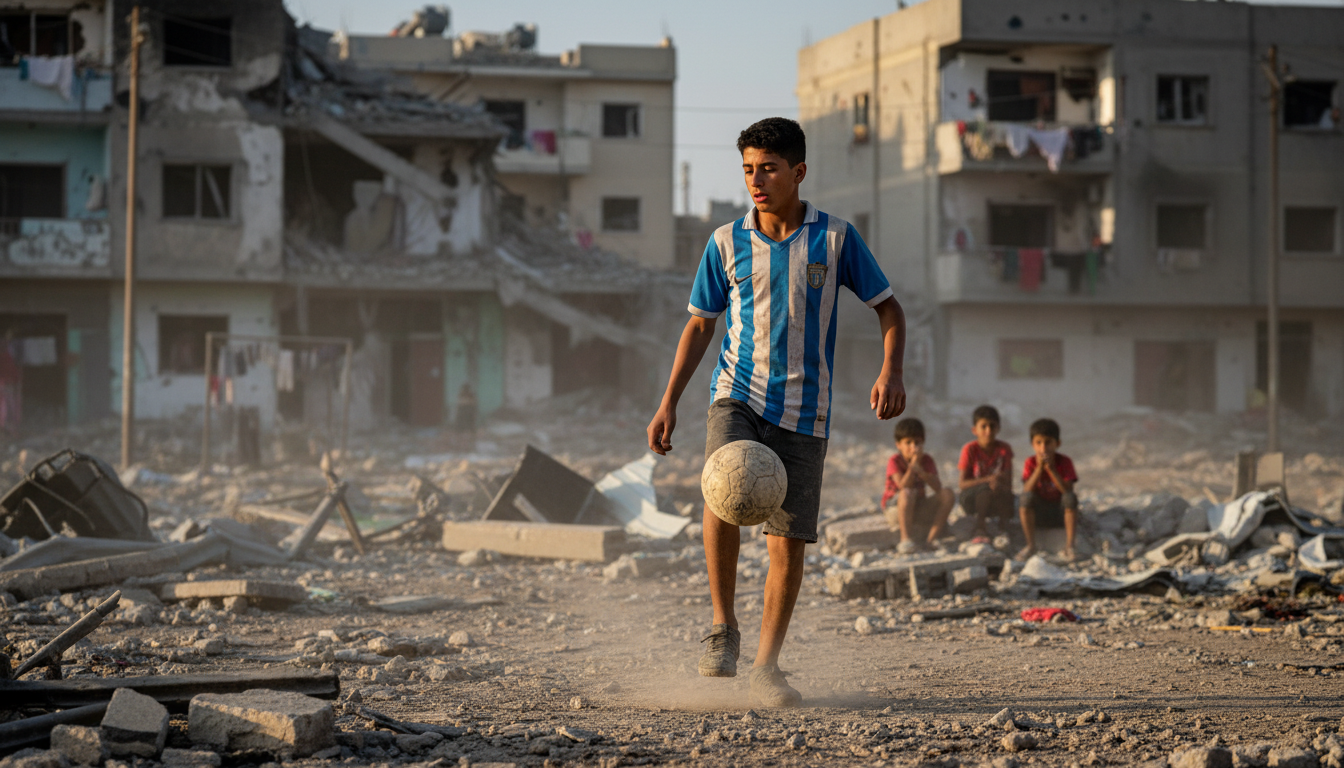
Gaza football: Teen survivor from Jabalia keeps dream alive after Oct. 11, 2024 strike
Gaza football: 16-year-old Mohammed Eyad Azzam lost his family in the Oct. 11, 2024 strike and clings to makeshift tournaments amid widespread damage to clubs.
Mohammed Eyad Azzam, a 16-year-old from Jabalia refugee camp, survived an Israeli airstrike on October 11, 2024 that flattened his family’s multi-storey home and killed his parents and two brothers. Thrust into the role of sole caregiver for his elderly grandmother, he now lives among displaced families in Shati camp and spends his days carrying water and tending small fires. Despite the trauma, Mohammed has returned to the sport that shaped his childhood, using Gaza football as a rare refuge from grief and daily hardship.
Survivor of October 11, 2024 strike becomes sole carer
Mohammed says he was buried beneath rubble for about ten minutes after the strike and was later pulled from the wreckage by his grandmother before waking up on a ventilator in a neighbour’s house. The intensity of ongoing bombardment prevented a formal burial, so he and neighbours interred his parents and brothers in a makeshift plot close to their destroyed home. Overnight he lost the protective framework of family life and has assumed responsibility for his grandmother while managing the psychological burden of bereavement.
He describes a rapid inversion of roles, from a pampered child and promising athlete to the main provider in a household reduced to a single elder and a teenage survivor. The loss has reverberated through his daily routine, forcing him to prioritize survival tasks over schooling or formal training. Yet he continues to seek moments of normalcy and discipline through the routines football still offers.
Football as a psychological lifeline
Before the escalation of hostilities that began in October 2023, Mohammed played for Khadamat Jabalia and was regarded as a promising talent within local youth ranks. With the club’s facilities destroyed and many teammates killed or displaced, organised training largely collapsed, but sporadic matches and small tournaments have re-emerged as crucial outlets. For Mohammed, lacing up his boots and playing on a patch of dirt or reclaimed ground provides a measure of psychological relief and a channel to process trauma.
He and other young players say the game helps dissipate anger, boredom and hopelessness, and offers a space where grief can be translated into focused effort rather than despair. The presence of a ball and a makeshift pitch does not erase loss, but it gives adolescents like Mohammed a sense of continuity and a tangible goal to pursue amid daily instability.
Palestinian Football Association stages youth tournament on limited pitches
The Palestinian Football Association (PFA) recently organised a youth tournament for players born in 2009 at one of the few remaining playable sites in the Gaza Strip. Matches have been restricted to just a handful of venues that remain usable, including Palestine Stadium in Gaza City, Khadamat Nuseirat and Ittihad Shabab Deir al-Balah. Organisers say staging events on these sites is an exercise in damage control: keeping youth engaged and preserving pathways for future development while reconstruction is impossible.
Tournament organisers and local officials emphasise the symbolic importance of those matches, which demonstrate resilience and sustain a pipeline of talent under extreme conditions. However, the scale and regularity of activity are severely constrained by infrastructure damage, security hazards and limited access to equipment and medical support.
Scale of damage: clubs, players and facilities devastated
According to figures circulated by the PFA, more than 1,100 people involved in the sports sector have been killed during the recent period of conflict, including over 560 players, coaches and administrators. The association reports that roughly 265 sports facilities have been destroyed or damaged across the Gaza Strip, and every one of the territory’s 56 football clubs has been affected to varying degrees. Entire club compounds, training grounds and youth academies have been rendered unusable, compounding the human toll with the loss of institutions that nurtured talent.
Khadamat Jabalia, the club where Mohammed once trained, was among those wiped out and its grounds were reportedly repurposed by occupying forces during operations. The destruction of such community anchors has narrowed opportunities for organised sport and removed an important social safety net for thousands of young people.
Journeys to matches remain perilous for young players
Even reaching the few remaining pitches requires long, physically taxing walks through tents, rubble and unstable urban terrain, with players reporting distances of three to four kilometres from makeshift shelters. The journey itself is described as psychologically draining and exposes children and teenagers to intermittent security risks, including the danger of renewed air strikes. Organisers acknowledge the peril but say the determination of participants compels them to continue arranging fixtures where possible.
Mustafa Siyam, head of media at the PFA in Gaza, has highlighted the courage of young athletes who risk daily hazards to play, noting that their persistence sends a message about youth resilience. At the same time, officials stress that sustained competitive development will remain stalled until security conditions improve and reconstruction of safe, regulated facilities can begin.
Calls for international sports bodies to respond
Palestinian sports officials have publicly criticised the international sports community, including FIFA, for what they view as an inconsistent response to the destruction of sports infrastructure and the deaths of athletes. They point to swift sanctions in other geopolitical contexts and argue that comparable measures or solidarity actions have been absent in the case of Gaza. With limited recourse through existing channels, the PFA has said it will pursue accountability through international sports tribunals and legal avenues.
The association and local clubs are seeking both emergency sport-specific aid and long-term commitments to rebuild pitches, academies and support services so that young players can return to regular training and talent identification. Until such mechanisms are in place, grassroots organisers and volunteers remain the primary drivers keeping competitive football alive in the Strip.
Mohammed says his ambition remains to become a professional footballer, a goal his late parents once shared when they enrolled him in the club as a child. He trains whenever and wherever he can, holding onto the belief that the game will offer a path out of the rubble and a way to honour his family’s memory. In a landscape marked by loss and disruption, his persistence illustrates how Gaza football continues to serve as both an anchor and an aspiration for the territory’s youth.
