
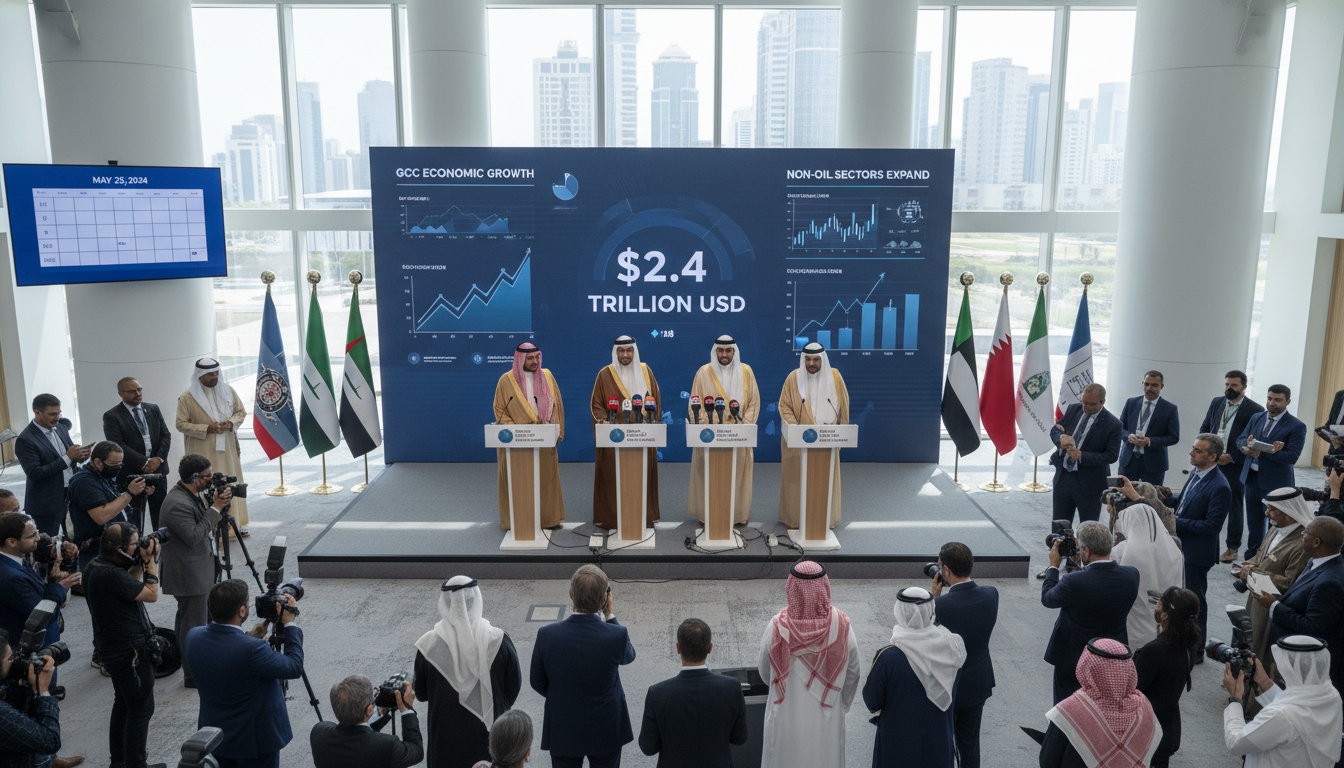
Gulf Cooperation Council economies mark May 25, 2026 anniversary with $2.4tn GDP and accelerated non-oil growth
On May 25, 2026 the Gulf Cooperation Council marks its anniversary as GCC economies report $2.4tn GDP, strong non-oil growth, banking gains and growing global investment influence.
The Gulf Cooperation Council will mark its anniversary on May 25, 2026 against a backdrop of robust economic indicators that signal deeper regional integration and successful diversification efforts across member states. Data released by the GCC Statistical Center show the bloc’s current GDP at approximately $2.4 trillion, while non-oil activities now contribute more than 78 percent of overall output, underlining a structural shift in GCC economies. The latest figures also point to broad-based strengths in banking, sovereign wealth capital and external trade that reinforce the region’s role in global markets.
May 25 anniversary and headline economic figures
The GCC Statistical Center’s recent compilation places the combined GDP of Gulf Cooperation Council economies at about $2.4 trillion, a marker of the group’s sustained economic scale and influence. Merchandise exports stood near $849.6 billion and total trade flows reached roughly $1.6 trillion, reflecting a 7.4 percent rise compared with 2023 that underscores expanding commercial activity. These headline numbers frame the anniversary as a moment to assess both past achievements and policy priorities for the next phase of integration.
Non-oil sector drives diversification gains
Policy shifts toward economic diversification are evident in the non-oil sector’s contribution exceeding 78 percent of GDP, with the non-oil economy expanding by 5.3 percent in 2025. Growth was supported by services, construction and private-sector activity, demonstrating that reforms and investment programs are translating into measurable output. Officials and analysts say the performance validates ongoing strategies to expand private sector employment and encourage value-added industries across the Gulf Cooperation Council.
Banking assets and liquidity point to financial resilience
The region’s banking system reported aggregate commercial bank assets of approximately $3.9 trillion, an increase of 11.9 percent between 2024 and 2025, while customer deposits rose to about $2.3 trillion with 10.6 percent growth. Those figures indicate robust liquidity and heightened depositor confidence in GCC economies, according to the statistical release. Credit availability and bank balance-sheet strength are being cited as important enablers for corporate expansion and infrastructure financing throughout the Gulf.
Sovereign wealth funds expand global investment footprint
Gulf sovereign wealth funds now manage an estimated $5 trillion in assets, representing roughly 30.3 percent of the world’s sovereign wealth pool and consolidating the GCC’s influence in global capital allocation. That concentration of state-backed long-term capital has helped member states support strategic investments abroad while underwriting domestic development programs. Observers note the funds’ size gives GCC economies leverage in international markets and provides an important buffer for fiscal planning amid commodity price volatility.
Trade volumes, energy output and tourism performance
Trade activity across Gulf Cooperation Council economies has risen sharply, with total exchanges around $1.6 trillion and merchandise exports near $849.6 billion, reflecting the bloc’s continued role in global supply chains. In energy, Gulf crude production averaged about 16.6 million barrels per day, or roughly 22.2 percent of global crude output, maintaining the region’s centrality to world energy markets. Tourism receipts also climbed, with revenues of approximately $132.3 billion, highlighting growing appeal as Gulf destinations attract leisure and business travelers.
Market integration, corporate capitalization and social mobility
Regional integration indicators show significant progress: intra-GCC trade reached about $146 billion, up 85.2 percent since 2012, while aggregate capital of listed joint-stock companies hit $549 billion, a 237.6 percent rise versus 2007. Social integration measures also advanced, with more than 41.4 million recorded movements of Gulf citizens between member states and roughly 43,200 Gulf students enrolled in partner-country public schools. Cross-border healthcare benefited nearly 488,900 citizens, reflecting both service integration and the practical benefits of cooperative policies among GCC economies.
The statistical snapshot released on the eve of the May 25, 2026 anniversary highlights a Gulf Cooperation Council that has leveraged energy revenues to build diversified, financially deep, and internationally connected economies. While the figures point to resilience and growing global influence, policymakers face ongoing tasks in translating investment capacity into inclusive employment, sustainable growth and private-sector-led innovation across the region.
