
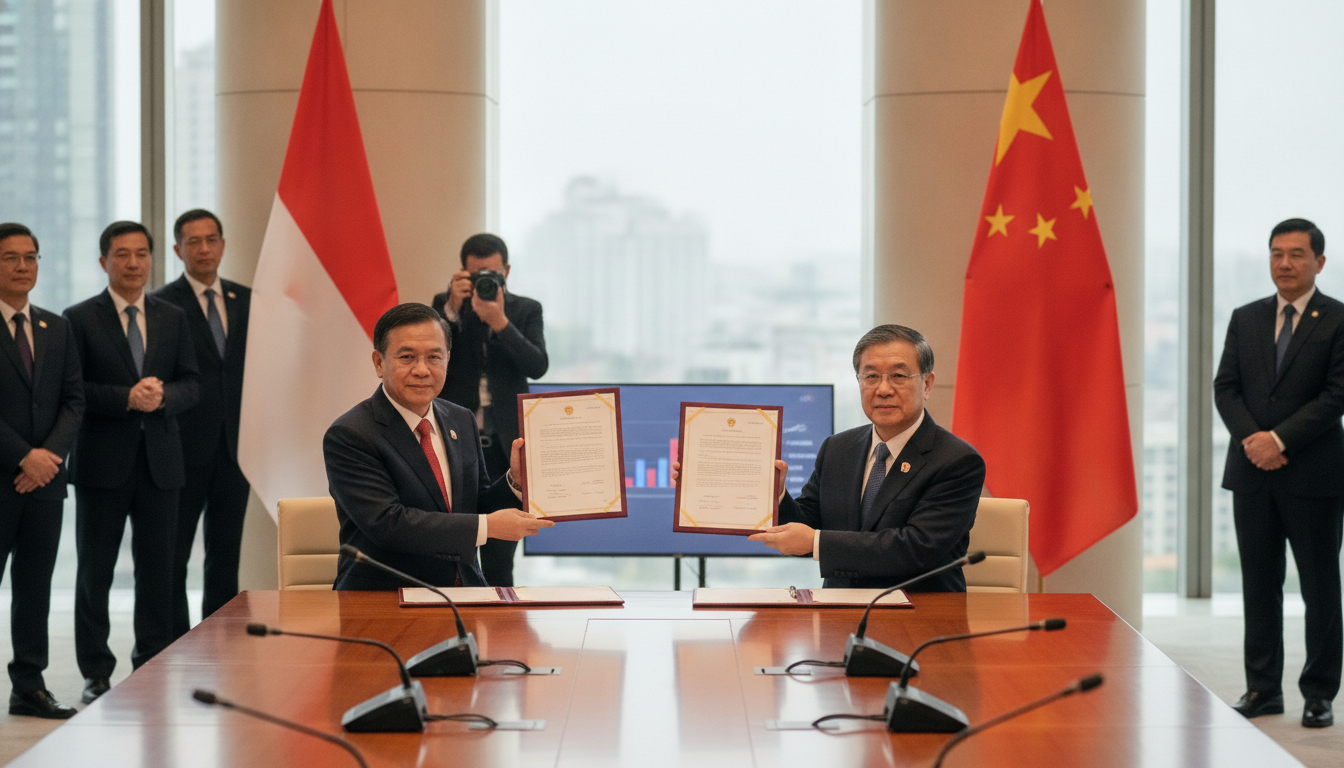
Indonesia-China local currency agreement in Shanghai aims to strengthen regional financial resilience
Indonesia-China local currency agreement signed in Shanghai on 11 June 2026 expands yuan-rupiah settlements, QR cross-border payments and regional swap lines.
The Indonesia-China local currency agreement reached in Shanghai on 11 June 2026 commits the two central banks to broaden yuan–rupiah settlements and deepen cross-border payment links. The deal, signed by Bank Indonesia Governor Perry Warjiyo and People’s Bank of China Governor Pan Gongsheng, aims to reduce reliance on third‑party currencies for trade and investment. Officials said the agreement includes measures on local currency transactions, expanded swap arrangements and new retail payment connectivity to facilitate smoother commerce between the countries.
Leaders who signed the pact in Shanghai
Bank Indonesia Governor Perry Warjiyo and PBOC Governor Pan Gongsheng signed the principal agreement during a high-level meeting in Shanghai on 11 June 2026. Hong Kong Monetary Authority CEO Eddie Yue also joined the ceremony, making the arrangement triangular in scope. The presence of the three officials underlined the initiative’s dual focus on bilateral cooperation and regional financial infrastructure.
Key components of the agreement
The central elements of the Indonesia-China local currency agreement include an expansion of local currency transactions (LCT) enabling direct yuan–rupiah settlement for trade and investment. The memorandum also expands a bilateral swap line and contemplates clearer arrangements for RMB clearing and settlement in Indonesia. Officials said the package is designed to lower conversion costs, shorten settlement times and provide a liquidity backstop at times of market stress.
Cross‑border retail payments and QR linkage
A notable operational measure is the launch of a cross‑border QR code payment link that connects Chinese and Indonesian payment providers. The service reportedly links 191 payment providers in China with 24 in Indonesia, allowing tourists, shoppers and small businesses to transact more easily. Supported by the LCT framework, the QR initiative aims to make everyday cross‑border retail payments faster and cheaper.
Swap lines and liquidity safeguards
The agreement reinforces existing currency swap mechanisms between Bank Indonesia and the People’s Bank of China to provide extra liquidity in periods of market turbulence. Swap lines let central banks supply each other with foreign currency liquidity, which can stabilise exchange markets and reassure domestic banks. Policymakers emphasised that the strengthened swap arrangements are intended as contingency tools rather than permanent substitutes for market funding.
Role of financial institutions and clearing infrastructure
The pact also advances operational integration by adding Indonesian participation in Chinese payment and clearing rails, including engagement with China’s interbank payment system. State-owned Bank Mandiri was named as a direct participant in China’s interbank payment channel, a move that could simplify RMB clearing for Indonesian corporates. Additionally, a memorandum on establishing RMB clearing and verification processes in Indonesia was signed to support smoother settlement of yuan‑denominated activity.
Implications for regional monetary architecture
Analysts and officials framed the Indonesia-China local currency agreement as part of a broader Asian trend toward diversified payment and settlement options. Rather than displacing established reserve currencies, the initiative is presented as a practical step to reduce transaction costs and vulnerability for economies that face capital flow volatility. By widening the menu of settlement choices, regional economies can build pragmatic buffers against external shocks while remaining integrated with global finance.
The agreement responds to growing concerns among emerging markets about sudden capital flow reversals and exchange rate shocks linked to global monetary shifts. Direct local‑currency settlement and enhanced liquidity arrangements can help importers, exporters and financial institutions hedge exposure and preserve trade continuity. For Indonesia and China, deeper currency cooperation also supports bilateral trade and tourism ties amid shifting global supply chains.
The initiative is likely to be watched closely across Asia as other economies weigh similar arrangements to enhance resilience without fragmenting international finance. Policymakers in the region view practical interoperability and scalable retail payment links as low‑friction steps that can be implemented relatively quickly. If the operational milestones—clearing capability, participant onboarding and liquidity testing—proceed smoothly, the agreement could serve as a model for more extensive regional settlement networks.
The Indonesia-China local currency agreement signed in Shanghai marks a deliberate move toward pragmatic diversification of payment and liquidity tools in Asia. With direct yuan–rupiah settlements, QR cross‑border retail payments and reinforced swap lines, the pact aims to lower costs, improve speed and provide defensive liquidity when global conditions tighten. As implementation unfolds, the effectiveness of these measures in dampening volatility and supporting trade will determine whether similar frameworks become a durable feature of the regional financial landscape.
