
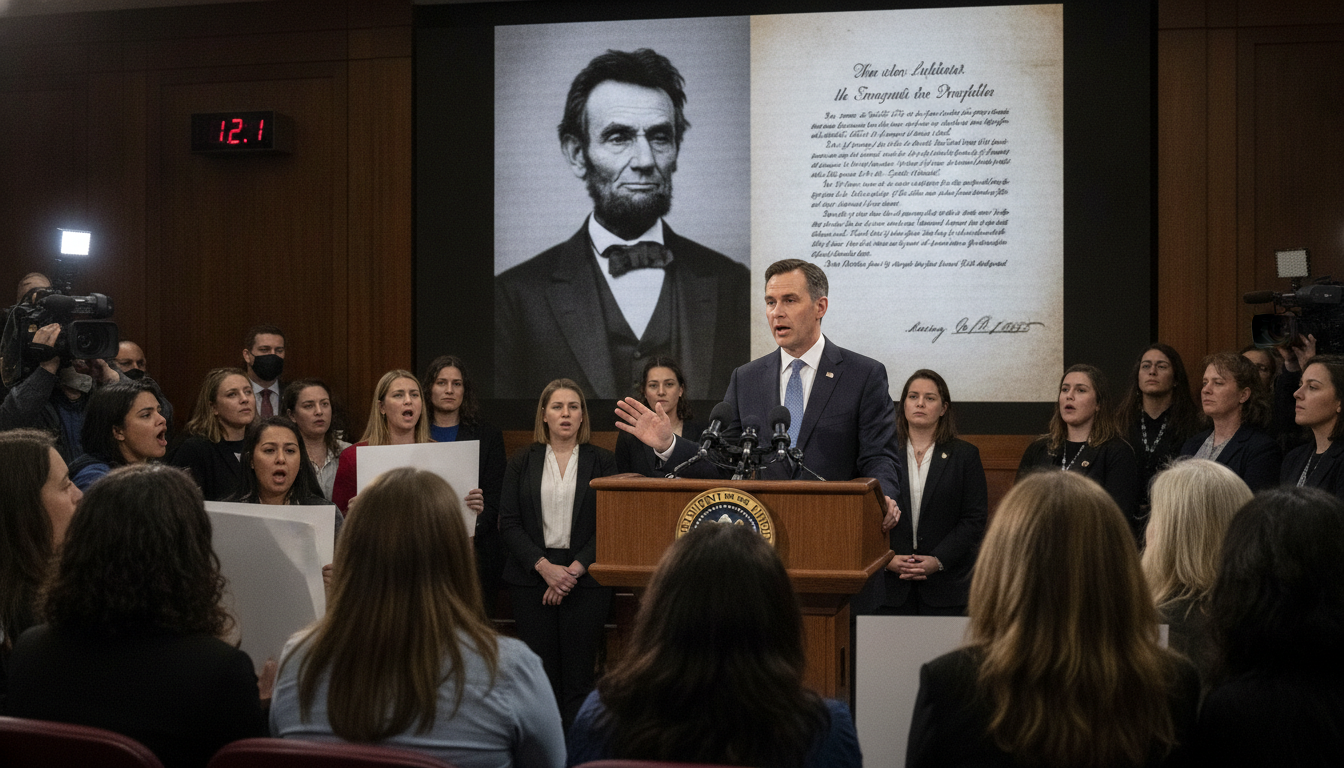
J.D. Vance abortion comparison sparks backlash after podcast remarks
Meta description: Vice President J.D. Vance’s comparison of anti‑abortion efforts to Abraham Lincoln’s fight against slavery drew sharp criticism and renewed debate over medication abortion policy.
Vice President J.D. Vance’s recent remarks likening efforts to restrict abortion to Abraham Lincoln’s campaign to end slavery have provoked widespread criticism and sharpened debate over U.S. reproductive policy. The J.D. Vance abortion comparison reportedly surfaced during a conservative podcast appearance and quickly circulated on social media, drawing rebukes from critics who called the analogy historically inappropriate. Vance is serving as vice president in the Trump administration, a post confirmed by the White House profile. (whitehouse.gov)
Vance’s podcast remarks and the Lincoln parallel
According to media reporting, Vance made the comparison while discussing strategies to curtail access to abortion medications and to sway public opinion on the issue. The comments echo earlier interviews in which Vance has drawn historical parallels between abortion and past moral struggles, a line of argument that has attracted controversy before. Critics say invoking Abraham Lincoln and slavery to frame a contemporary policy fight risks inflaming tensions and trivialising a profoundly different historical atrocity. (toppodcast.com)
Vance’s defenders argue he was stressing the need to work through legal and institutional channels rather than endorsing extralegal measures, and they say historical analogies are intended to cast the debate in moral terms. Opponents counter that equating a woman’s reproductive autonomy with chattel slavery is both inaccurate and offensive, and they point to the sensitive legal and ethical ground surrounding abortion. (washingtonpost.com)
Policy backdrop: Dobbs and shifting authority
The remarks come against a backdrop of deep legal change since the U.S. Supreme Court’s 2022 Dobbs decision, which removed a federal constitutional right to abortion and returned regulatory authority largely to the states. That ruling reshaped political incentives and left medication abortion — particularly the drug mifepristone — at the center of a new front in the national fight over access. The Dobbs decision remains a central reference point for both supporters and opponents of expanded restrictions. (theguardian.com)
States and federal agencies have since become focal points of policy contention, with governors and legislatures moving in divergent directions and court battles testing the reach of state and federal authority. The public-policy environment has made statements by senior officials on reproductive issues especially consequential in the run-up to midterm and presidential election cycles. (apnews.com)
Regulatory pressure on abortion pills
Concurrently, the Department of Health and Human Services and the Food and Drug Administration announced a review of mifepristone and related safety protocols last year, a move initiated by the administration’s health officials and prompted by petitions from conservative state attorneys general. That review, confirmed in September 2025, has kept the future of mail‑order and wider distribution of medication abortion under scrutiny and fuelled concern among reproductive‑rights advocates. (axios.com)
Federal courts have also weighed in on aspects of medication‑abortion policy, and judges have at times pressed the FDA for updates on its safety review, underscoring the legal uncertainty that now surrounds long‑established approvals and dispensing practices. Advocates for access warn that regulatory changes could severely restrict a method that accounts for a large share of U.S. abortions. (notus.org)
Political fallout and public reaction
Vance’s comments quickly generated a wave of criticism on social platforms and from political opponents, who argued that comparing the modern political struggle over abortion to the moral and constitutional campaign to end slavery was inappropriate. Commentators from across the spectrum said the analogy risked inflaming cultural wounds while deflecting from policy specifics such as how restrictions would be implemented and what exceptions, if any, would apply. (ohiodems.org)
Some conservative commentators and supporters framed the remarks as a call to build public consensus and craft incremental legal strategies, not as an attempt to rewrite history. But the public response underscored how charged and symbolic language can alter the political terrain, galvanising both supporters and opponents ahead of key legislative and judicial fights. (washingtonpost.com)
Democrats and civil‑rights groups respond
Democratic officials and national advocacy groups moved swiftly to condemn the comparison and to reiterate their commitment to defending reproductive rights. The Democratic National Committee and allied organisations have framed recent federal and state moves as part of a broader campaign to curb reproductive health services, and they vowed to keep reproductive access central to their messaging and electoral strategy. (democrats.org)
Civil‑rights organisations and medical associations warned that rhetoric equating abortion with historical atrocities distracts from evidence‑based debate about patient safety, clinical practice, and access to care. Health experts also emphasise that policy changes affecting Title X family‑planning funds and Medicaid rules have immediate consequences for clinics that provide contraception, cancer screenings and other preventive services. (kff.org)
Where this leaves the national debate
The episode highlights how individual statements by senior officials can reverberate beyond immediate policy circles and reshape public debate. With federal agencies reviewing medication‑abortion rules, state legislatures pursuing divergent paths, and a high‑stakes election calendar ahead, rhetorical flashpoints are likely to influence legislative priorities and courtroom dynamics. Observers say the challenge for policymakers is to translate moral conviction into legally sustainable and politically manageable proposals. (axios.com)
Vance’s comparison, whether intended as historical framing or political argument, has intensified scrutiny of both the administration’s reproductive‑health agenda and the language used to defend it. As legal reviews proceed and political campaigns intensify, the intersection of moral rhetoric, public policy and medical regulation will remain a volatile and closely watched element of American political life.
