
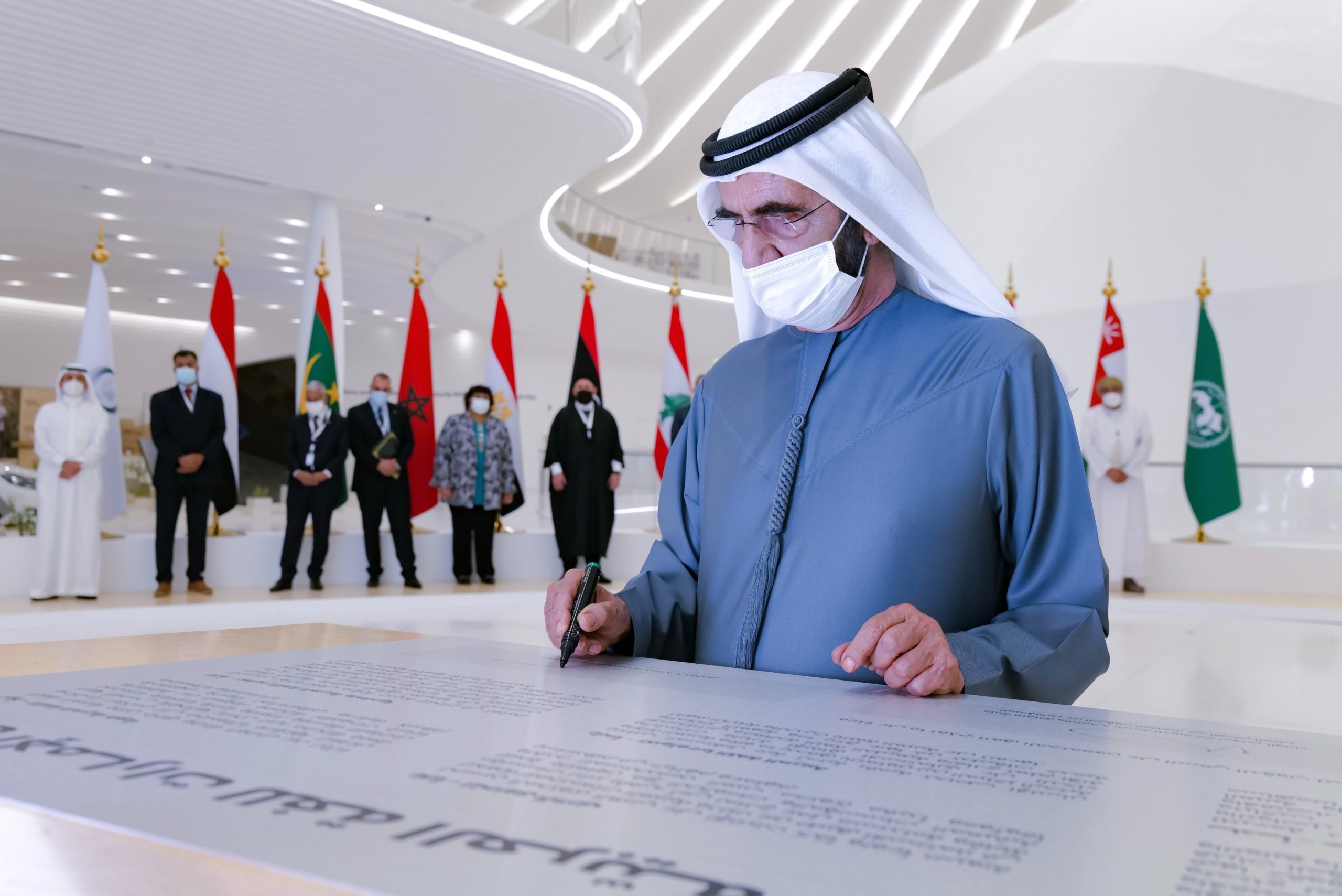
His Highness Sheikh Mohammed bin Rashid Al Maktoum, Vice President and Prime Minister of the UAE and Ruler of Dubai, may God protect him, witnessed the launch of the “UAE Declaration for the Arabic Language” at the UAE Pavilion at Expo 2020 Dubai, in the presence of their Excellencies the Arab Ministers of Culture, coinciding with the International Arabic Language Day. On the sidelines of the 22nd session of the Conference of Ministers Responsible for Cultural Affairs in the Arab World, which will be held at Expo 2020 Dubai.
His Highness Sheikh Mohammed bin Rashid Al Maktoum said: “Today, accompanied by the Secretary-General of the League of Arab States and the Arab Ministers of Culture, I attended the Arabic Language Summit at Expo Dubai, which is organized by the Ministry of Culture and Youth in the country… The Arabic language deserves many summits because it is a summit in beauty… and a summit in breadth and comprehensiveness.” …and its pinnacle in being a container for civilization in all its dimensions.”
His Highness added: “At the summit, I also witnessed the signing of the UAE Declaration for the Arabic Language, along with the Arab Ministers of Culture, and I signed it with them. Through it, we declare our commitment to it as the language of our identity, culture, and sciences. We are committed to it as the language of life.”
The announcement was launched in the presence of His Highness Sheikh Hamdan bin Mohammed bin Rashid Al Maktoum, Crown Prince of Dubai, and His Highness Sheikh Maktoum bin Mohammed bin Rashid Al Maktoum, Deputy Ruler of Dubai, Deputy Prime Minister and Minister of Finance. The launch was also attended by His Excellency Mohammed bin Abdullah Al Gergawi, Minister of Council Affairs. The Ministers, Her Excellency Reem bint Ibrahim Al Hashemi, Minister of State for International Cooperation, and Her Excellency Noura Al Kaabi, Minister of Culture and Youth and President of the 22nd session of the Conference of Ministers Responsible for Cultural Affairs in The Arab world.
The UAE Declaration for the Arabic Language was signed alongside His Highness by His Excellency Ahmed Aboul Gheit, Secretary-General of the League of Arab States, His Excellency Muhammad Ould Omar, Director-General of the Arab League Educational, Scientific and Cultural Organization, and His Excellency Noura bint Muhammad Al-Kaabi, so that the declaration becomes a unified road map for all institutions in the Arab countries. .
Her Excellency Noura bint Mohammed Al Kaabi, Minister of Culture and Youth, presented to His Highness Sheikh Mohammed bin Rashid Al Maktoum an explanation about the “UAE Declaration of the Arabic Language” and the Ministry’s efforts to preserve the Arabic language and enhance its presence locally and globally.
Her Excellency Noura Al Kaabi said: “The report on the status of the Arabic language and its future in its first edition revealed the necessity of coordination and cooperation between the Arab countries through sound linguistic planning and joint Arab action, and today we are taking an important step on the path to implementing the recommendations and outcomes of the report by launching the UAE Declaration for the Arabic Language, which represents a comprehensive road map.” Covering all fields related to the Arabic language.
She added: “The UAE Declaration of the Arabic Language is a reference for officials in Arab countries to launch initiatives and projects that preserve the Arabic language, enhance its presence among future generations, and at the same time anticipate its future in the digital space, new worlds, and industries related to the Arabic language, and employ contemporary technology in teaching and disseminating the Arabic language.” To become a language for the present and the future.
Last year, the Ministry of Culture and Youth launched a report on the status of the Arabic language and its future, with the participation of 15 media institutions, 10 language academies, and 18 universities from around the world. 65 institutions contributed to preparing the report.
The UAE Declaration for the Arabic Language includes ten basic items:
First – the Arabic language is an identity
The Arabic language is a unifying homeland, the link between our heritage and our present, reflecting the richness and diversity of our societies, in which classical Arabic and its dialects interact in a unique way, forming a lever for our civilization, culture, literature and arts, a means of communication and understanding between our peoples, an enabler of the ambitions and dreams of our youth, a voice for their feelings, and a pillar for the prosperity of our societies and economies.
Second: Teaching and learning the Arabic language
Establishing an effective direction and a new vision for success in teaching the Arabic language and developing the methods of teaching it in schools is a necessary need for the development of our societies and the growth of our economies. This is achieved in cooperation with specialized research centers to provide modern curricula based on best international practices, and to develop programs to prepare teachers of the Arabic language and enhance their knowledge and abilities to teach it in a manner Scientific knowledge that facilitates learning and brings it closer to new generations.
Third – Arabic content
Improving the quantity and quality of Arabic content on the Internet is a development necessity for Arab societies, by investing in digital publishing institutions that build sustainable and viable business models in cooperation with governments and knowledge institutions and provide Arab users with useful and reliable content that helps them in their lives and work.
Fourth – Arabic language technology
The future requires a digital infrastructure that addresses Arabic humans and machines, which will be achieved through cooperation between research centers and companies, and increased investment spending on artificial intelligence, natural language processing, machine learning models, linguistic thesauri, and the resulting service applications that understand writing and speaking in the Arabic language in all its diversity.
Fifth: Industries related to the Arabic language
Industries based on the Arabic language, such as education, media, and publishing, are major partners for policy and economic makers in enhancing the presence and prosperity of the Arabic language, and they need development grants and an advanced investment environment in which intellectual property rights are applied to confront piracy and build the capabilities of private institutions in the areas of business development, distribution, and marketing.
Sixth: Translation movement
Translation has an essential role in transferring and localizing knowledge and communicating between cultures, and in enriching the Arabic language with new expressions, structures, and terms that affect society, the economy, education, and the media. Developing and investing in translation from and into Arabic is necessary to enhance our contribution to knowledge creation.
Seventh: Arabic language and sciences
The Arabic language, which in its past was an incubator for research and discovery in its societies, today needs the availability of modern knowledge in Arabic in order to achieve a bright future for its children, by investing in the translation of science and research, and in scientific research according to our development needs. It also needs to connect Arab researchers with networks that share their scientific product. Among them and make it available to researchers in other languages.
Eighth: The Arabic language is a global language
The Arabic language is one of the world’s most widely spoken languages. It is a language of communication and cultural production, and through it we enhance the presence of our culture, thought, and civilizational contributions. This is enhanced by building global partnerships with academic institutions and cultural centers and supporting efforts to teach them in new worlds.
Ninth – National references and policies
Arab societies need sound linguistic planning that governments and all types of societal institutions can cooperate to draw up, translated into linguistic policies in the fields of education, media, public space, and industries related to the Arabic language, and into cooperation between the various Arabic language authorities in our countries, each according to its priorities and needs.
Tenth – The future of the Arabic language
Arabic is a language for grandparents and children, always evolving and changing like any living language. It is the language of religion and heritage, just as it is the language of life, economy, art and science. We build on its past as we shape its future with confidence and faith, and establish modern approaches that go beyond what has become neglected and accommodate the challenges and opportunities that the acceleration of friction between the world’s languages and cultures brings.
Follow our latest local and sports news and the latest political and economic developments via Google news
