
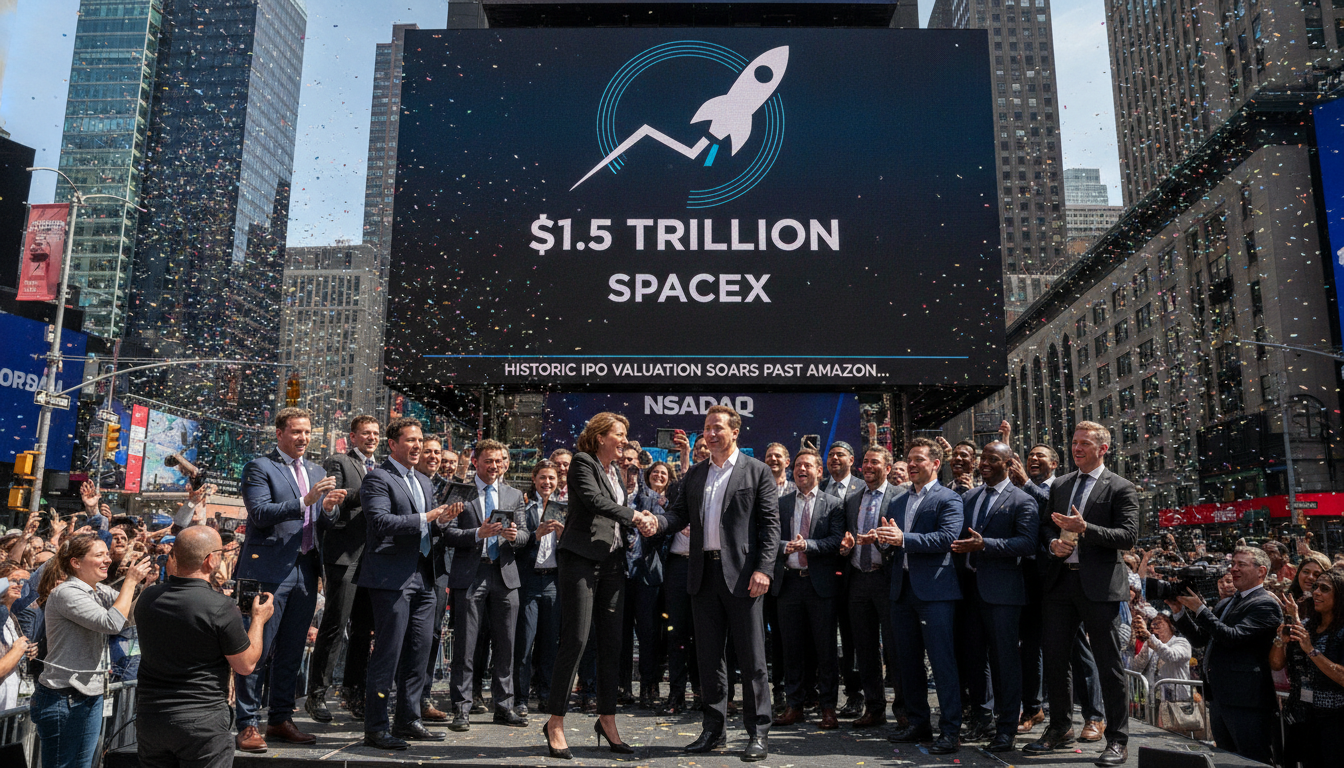
SpaceX IPO Rally Pushes Company Past Amazon to Become World’s Fifth-Largest
SpaceX IPO surge lifts market value past Amazon as shares rally, putting the company within reach of Microsoft after a historic offering that raised roughly $86 billion.
SpaceX Post-IPO Rally Lifts Market Value Above Amazon
Shares of SpaceX jumped again on Tuesday as the post-IPO momentum continued, placing the company ahead of Amazon by market value and moving it into the world’s top five.
Premarket gains of around 10% pushed the stock above $210 and lifted SpaceX’s market capitalisation to roughly $2.8 trillion, according to market reports. (investing.com)
Investor appetite since the company’s Nasdaq debut has been intense, with trading volumes well above the levels seen for most new listings this year.
Analysts say the combination of Starlink revenue, government launch contracts and the company’s AI ambitions has fuelled speculative flows into the stock. (investing.com)
Historic Offering Raised More Than Initially Planned
SpaceX priced its initial offering at $135 a share, which under the planned size amounted to a $75 billion raise, the largest in U.S. history at the time of pricing.
Underwriters exercised their over-allotment option, expanding the sale and bringing the total proceeds to about $85.7–86 billion, a move that topped earlier estimates. (techcrunch.com)
That extra supply of shares helped meet unusually strong demand from institutional and retail investors, while securing a record-setting capital injection for the company.
Market participants said the exercise of the option reflected both demand and underwriters’ willingness to stabilise the float during early trading. (techcrunch.com)
Trading Debut Showed Volatility and a Strong Pop
SpaceX made a high-profile Nasdaq debut on Friday, with the stock rallying into double-digit gains on its first day of public trading.
Shares climbed as much as 19% in intraday trade and closed substantially above the offering price, a sign of the premium investors placed on access to the new public equity. (techcrunch.com)
Market watchers noted that price discovery and intermittent volatility were expected for a listing of this size, and that weekend and early-week moves reflected both momentum trading and portfolio rebalancing by large funds.
Regulatory filings and the company’s disclosure about revenue and growth prospects were central to early analyst commentary. (techcrunch.com)
Big Tech Rankings Reshuffled After the Listing
The listing immediately altered the ranking of the largest public companies, with SpaceX entering the upper echelon behind the AI chip and consumer-tech leaders.
Nvidia remains the largest by market value, trading above the $5 trillion mark, while Alphabet, Apple and Microsoft continue to sit ahead of or near SpaceX depending on intraday swings. (financecharts.com)
The move put pressure on passive funds and indices, and some portfolio managers said they would review index weights and allocation limits as SpaceX’s size stabilises.
Market structure specialists warned that rapid reweighting in major indexes could amplify short-term volatility in both SpaceX and other mega-cap stocks. (investing.com)
Underwriters, Banks and the Roadshow Dynamics
Major banks that led the IPO played a central role in managing demand and expanding the offering size to capture more investor interest.
Goldman Sachs, Morgan Stanley and other underwriters exercised the greenshoe and coordinated allotments to institutional clients, according to market reports. (techcrunch.com)
The success of the deal will be assessed not only by the proceeds raised but also by how smoothly trading and settlement proceed in the coming weeks.
Some analysts highlighted governance structures and the company’s dual-class share considerations as important factors for long-term equity investors. (techcrunch.com)
SpaceX’s market debut and subsequent rally represent a landmark moment for the aerospace and satellite sectors, and the listing has already prompted comparisons with the largest tech and chipmakers.
As trading continues, investors and regulators will watch for signs of stabilisation in price, volume patterns and any broader effects on index composition and sector flows.
