
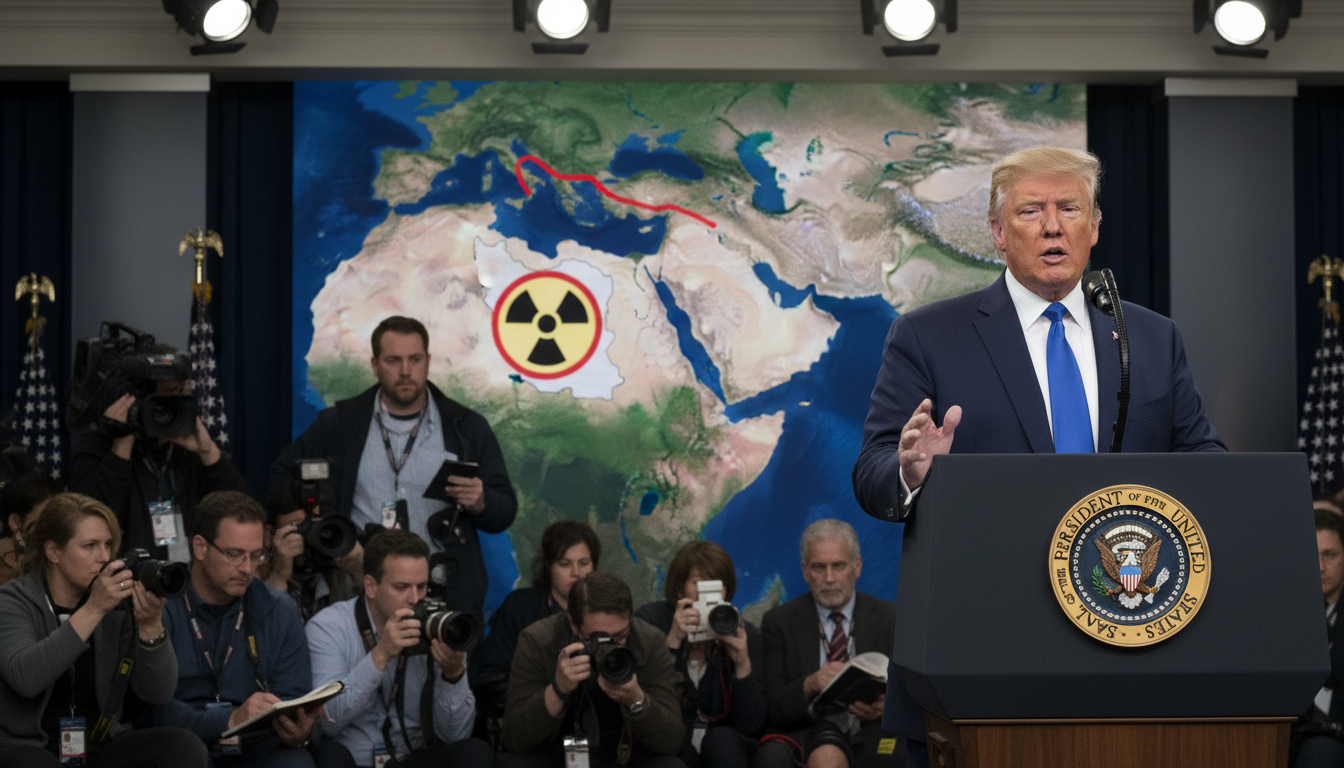
Trump warns Iran: US will not allow nuclear weapon and asserts control of Strait of Hormuz
Trump warned Iran the US will prevent it from acquiring nuclear weapons, asserted control of the Strait of Hormuz and said military action remains possible.
President Donald Trump warned Iran on Wednesday that the United States will not permit Tehran to obtain a nuclear weapon that threatens the Middle East or the United States. Trump warned Iran in remarks to reporters at the White House that Washington would pursue a military end to hostilities if no diplomatic agreement is reached. He also said the United States currently exerts full control over the strategic Strait of Hormuz and signalled that the waterway would be reopened only with a deal or if other measures are taken.
President’s declaration on Iran’s nuclear capability
Trump reiterated that preventing Iran from acquiring a nuclear weapon is a core U.S. objective and framed it as a direct security imperative for the region and the homeland. He said the United States would not allow any actor to deploy a nuclear device and emphasized that this stance guides Washington’s approach to Tehran. The president’s comments underline a continuity in U.S. policy that links non-proliferation goals with readiness to use force when deemed necessary.
Military action if diplomacy fails
The president told reporters that, if negotiations break down, the United States would bring an end to conflict with Iran through military means. That warning framed diplomacy as conditional, tying the prospect of talks to Iran’s behaviour and compliance. While Trump positioned military action as a last resort, his remarks left open the possibility of escalation if a diplomatic path does not produce a deal acceptable to Washington.
Nuclear strike explicitly excluded
When asked about the use of nuclear weapons in any potential conflict with Iran, Trump rejected the option, saying that nuclear strikes should not be used by any party. He made clear that while military action could include conventional force, the use of nuclear arms was off the table. The distinction aimed to reassure interlocutors that U.S. strategic doctrine would not cross the threshold into nuclear employment, even amid heightened tensions.
Control and future of the Strait of Hormuz
Trump asserted that the United States has “complete control” over the Strait of Hormuz, a key artery for global oil shipments, and linked access to the waterway to diplomatic progress. He said the strait would be reopened when an agreement is reached or if other unspecified developments occur. That statement signals intent to use naval and coalition capabilities to influence maritime passage, a move which would have direct implications for regional trade and energy markets.
Regional reaction and diplomatic stakes
The president’s remarks are likely to reverberate across Gulf capitals concerned with stability, shipping traffic and the risk of military escalation. Regional governments will weigh Washington’s warnings against their own economic and security calculations, including the potential fallout for energy supplies. Diplomats in the region are expected to intensify consultations as they assess the prospects for renewed talks with Tehran and the possible need for de-escalatory measures.
Implications for international partners and markets
International partners, including European allies and global energy consumers, face a delicate balancing act in responding to U.S. warnings while pursuing diplomatic avenues to reduce the risk of conflict. Markets may react to assertions about control over the Strait of Hormuz, where disruptions historically drive spikes in oil prices and shipping insurance costs. Countries dependent on Gulf energy flows are likely to press for clarity on contingency planning and routes to safeguard trade.
The president’s statements mark a forceful reiteration of U.S. policy priorities toward Iran and the wider Gulf, blending diplomatic pressure with the explicit threat of conventional military action. Trump warns Iran that negotiation remains the preferred channel but also made clear that Washington considers preventing a nuclear-armed Tehran an uncompromising objective.
