
U.S. destroyers in Gulf of Oman fortify defenses as Iran escalates maritime threats
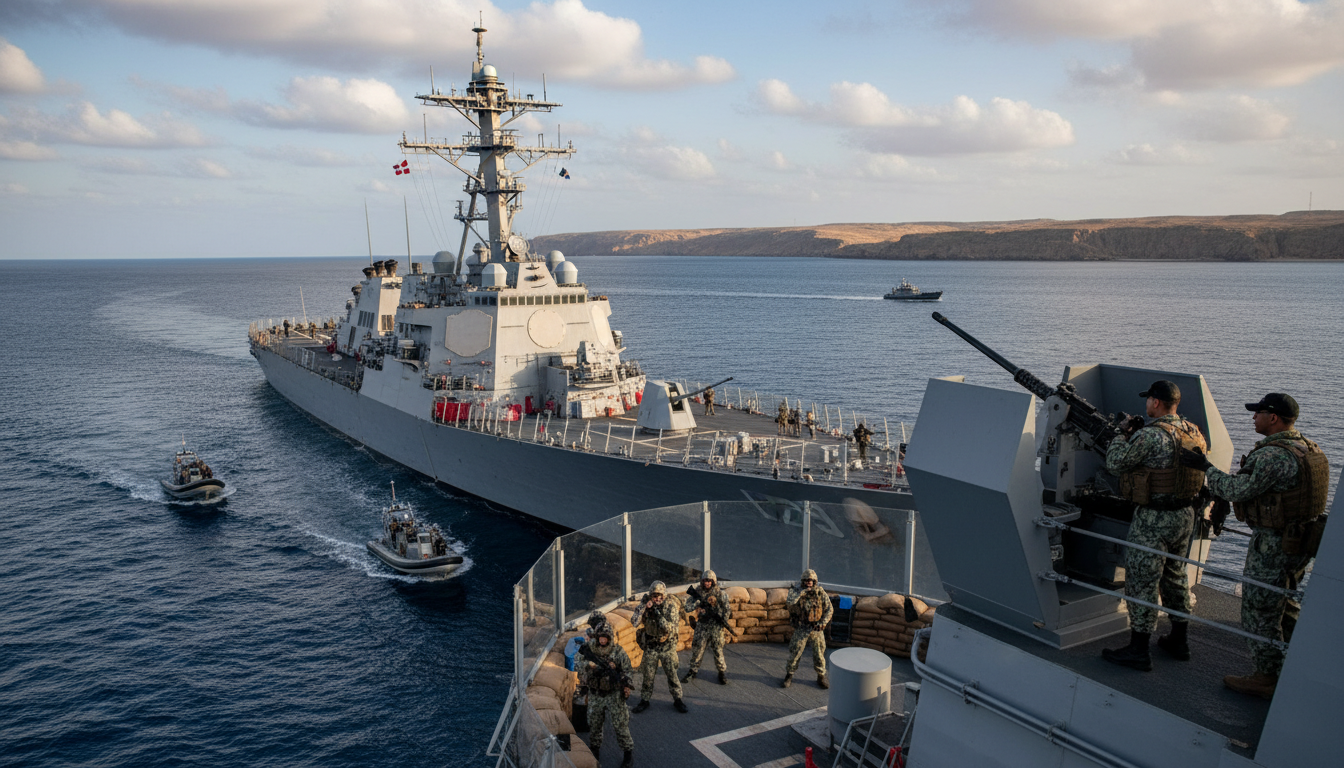
U.S. destroyers in the Gulf of Oman are operating further from the Strait of Hormuz while enforcing a blockade, applying lessons from the USS Cole amid threats from mines, missiles, drones and small boats.
The U.S. Navy has deployed a flotilla of Arleigh Burke-class destroyers to the Gulf of Oman and Arabian Sea to press Iran’s maritime chokehold and protect freedom of navigation. Commanders say the posture reflects a balance between deterring Iranian exports and keeping ships at a distance where early detection and layered defenses improve survivability. Recent incidents — including reported attacks on merchant vessels and the seizure of an Iranian cargo ship — have sharpened urgency in Washington and allied capitals.
Lessons from the USS Cole
The 2000 bombing of the USS Cole remains a touchstone for modern naval defense planning. A small fiberglass skiff packed with explosives inflicted catastrophic damage on the destroyer while it was in port, killing 17 sailors and highlighting how low-cost, asymmetric attacks can threaten high-value warships.
That attack prompted systematic changes in force protection, training and equipment across the fleet. Navy leaders have repeatedly cited Cole-era vulnerabilities when arguing for investments in short-range firepower, improved surveillance and tactics to counter small-boat approaches and explosive-laden craft.
Deployment of U.S. destroyers in Gulf of Oman
Current deployments place roughly a dozen destroyers in the Gulf of Oman and the Arabian Sea, positioned hundreds of miles southeast of the Strait of Hormuz. Officials say this distance allows better time to detect and engage threats while still providing a screen for shipping approaching or leaving Iranian ports.
The ships’ missions include enforcing a de facto blockade intended to pressure Iranian oil exports, escorting commercial traffic when needed, and maintaining readiness to respond to mine-laying, missile launches or swarming boat attacks. The dispersed posture reflects caution about concentrating forces too close to hostile shores.
Iran’s asymmetric naval threat
Iran has developed a layered maritime threat that blends conventional weapons with irregular tactics. Land-based anti-ship cruise missiles, fast-attack “mosquito” boats operated by the Revolutionary Guards, and aerial assets such as Shahed loitering munitions create a spectrum of danger for any vessel transiting coastal approaches.
Tehran has also used sea mines and worked through proxy groups, including Houthi forces in Yemen, to project power across the Red Sea and Arabian Peninsula. Analysts warn that these tools are inexpensive and deniable, complicating attribution and response options for Western navies.
Navy defensive upgrades since Cole
Since the Cole bombing, the Navy instituted a dedicated program to field more short-range defensive weapons and tactics to counter small-boat threats. Ships now carry improved automatic weapons packages, grenade launchers, and specialized 5-inch ammunition designed to defeat agile surface attackers at range.
Seahawk helicopters embarked on destroyers add another layer of defense, providing organic sensors and precision munitions such as Hellfire missiles and laser-guided rockets. Those helicopters extend a ship’s engagement envelope well beyond the horizon, allowing interdiction before attackers reach lethal range.
Drones and unmanned maritime swarms
Unmanned systems have reshaped modern naval combat, with recent conflicts demonstrating how drones and sea-skimming missiles can degrade larger fleets. A swarm of unmanned surface vessels or small explosive boats presents a particular challenge because volume and unpredictability can overwhelm shipboard defenses.
Reaper and other surveillance drones can provide early warning and even conduct interdiction if armed, but they often operate from distant land bases and may not be immediately available. That promptness gap is why leaders emphasize a mix of sensors, organic aviation and munitions tailored to counter massed small-boat or unmanned attacks.
Operational posture balances detection and risk
Placing destroyers farther from shore is a deliberate trade-off: it increases reaction time and reduces exposure to shore-launched missiles, but it can complicate direct presence near contested choke points. U.S. planners appear to favor a layered approach that uses long-range ISR assets, forward-deployed air patrols and carrier or expeditionary strike groups positioned to respond as needed.
Commanders have also stressed the value of multinational cooperation and intelligence sharing to track possible mine-laying or coordinated small-boat operations. The goal is to deny adversaries opportunities for surprise while minimizing the tactical risks inherent in close-blockade operations.
Recent confrontations and enforcement actions
Tensions have manifested in reported attacks on commercial vessels and confrontations at sea, including the U.S. seizure of an Iranian cargo ship said to have violated the blockade. Such incidents underline how enforcement activities can escalate quickly and why rules of engagement and attribution remain central to operational planning.
Pentagon briefings have shown commanders mapping destroyer locations and coordinating air support to sustain patrols, reflecting a campaign-style effort to pressure Iran’s maritime economy without tipping into broader conflict. The outcome will hinge on deterrence, detection and the ability to defend against low-cost asymmetric tactics.
The Navy’s current mix of ships, helicopters, drones and upgraded munitions reflects lessons learned over two decades of operating in contested waters, but analysts warn no single measure eliminates risk. As the standoff continues, commanders will rely on layered defenses, allied cooperation and persistent surveillance to protect ships and keep vital sea lanes open.
