
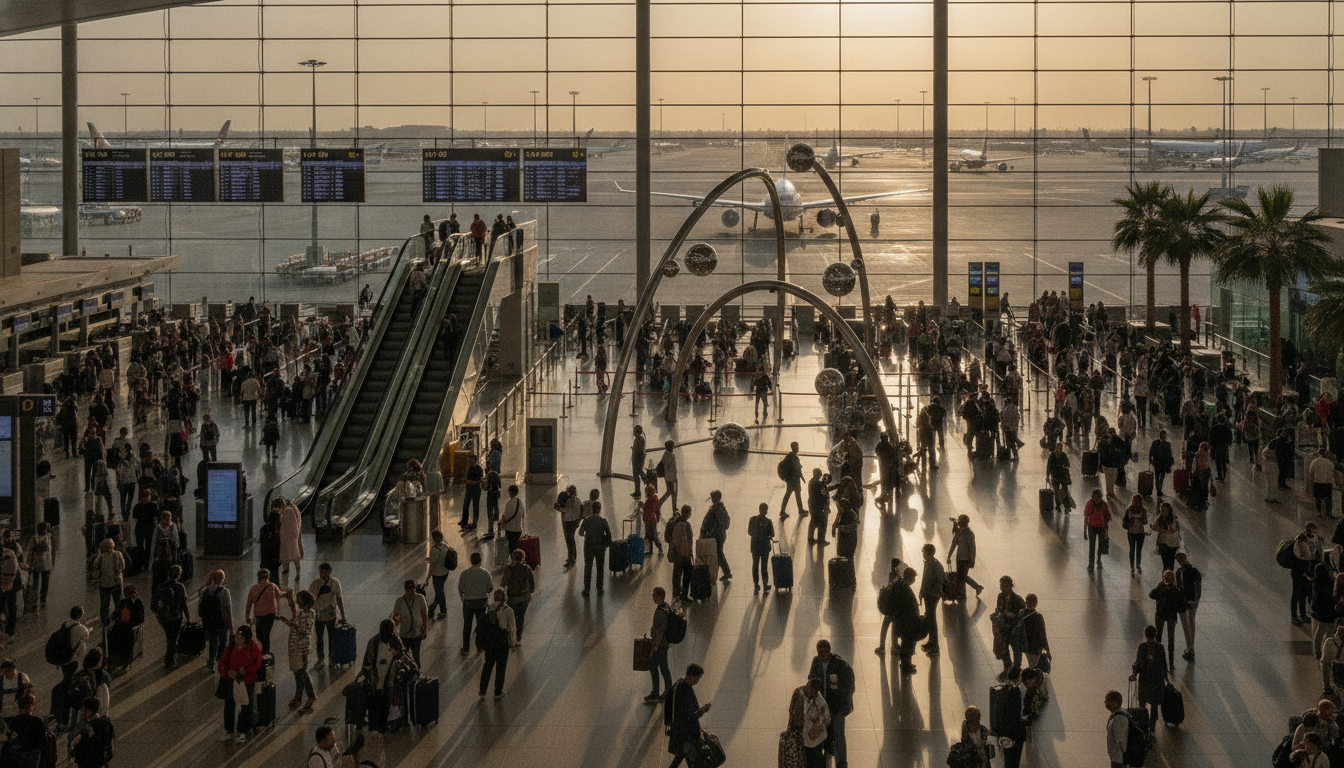
UAE airports 2025: Passenger traffic hits 156.8 million as aircraft movements rise
UAE airports 2025 record: 156.8 million passengers and 855,300 aircraft movements, highlighting infrastructure investment and sustained aviation growth.
The United Arab Emirates recorded a landmark year for air travel in 2025 as UAE airports 2025 traffic climbed to 156.8 million passengers, driven by robust growth in transit and inbound travel. Data released by the Federal Competitiveness and Statistics Centre show a 6.1% increase in total passenger volumes versus 2024, underlining the sector’s central role in the country’s transport and tourism ecosystem. Officials attributed the gains to strategic infrastructure investments, expanded airline services and strong regional demand that maintained the UAE’s position as a global aviation hub.
Passenger traffic hits 156.8 million in 2025
The Federal Competitiveness and Statistics Centre reported that total passenger movement across UAE airports—arrivals, departures and transit—reached 156.8 million in 2025, up from 147.8 million in 2024. The rise of 9 million passengers represents a 6.1% year-on-year increase and reflects growth across all travel categories, with transit passengers showing particularly strong gains. Arrivals rose to 44.2 million and departures to 43.0 million, while transit volumes expanded to 69.5 million.
Dubai maintains largest share with 104.5 million passengers
Dubai’s airports together handled 104.5 million passengers in 2025, retaining the emirate’s status as the country’s busiest aviation hub and a primary gateway between East and West. That figure compares with 100.9 million in 2024, a 3.5% increase, and includes 30.2 million arrivals, 29.5 million departures and 44.7 million transit passengers. The performance underscores Dubai’s continued role as a major transfer hub and its capacity to sustain high-frequency international connectivity.
Abu Dhabi, Sharjah and Ras Al Khaimah post double-digit gains
Abu Dhabi’s airports reported 34.2 million passengers in 2025, up from 30.8 million the previous year, marking a 10.7% increase and signaling accelerated growth in both scheduled services and transfer traffic. Sharjah International Airport recorded a similar percentage gain, reaching 16.9 million passengers compared with 15.2 million in 2024. Smaller airports also posted notable rises: Ras Al Khaimah surpassed the one million passenger mark in 2025, up from 639,300 in 2024, a jump of 56.8%, while Fujairah saw passenger numbers increase by 170% to 164,600.
Aircraft movements rise to 855,300 with balanced arrivals and departures
The growth in passenger volumes was matched by higher aircraft activity, with total movements across the UAE reaching 855,300 in 2025, an increase of 6.8% from 801,000 in 2024. Arrivals totaled 414,300 movements while departures were recorded at 414,100, both up approximately 7.3% year-on-year. The data indicate a balanced uptick in inbound and outbound operations and reflect expanded airline schedules, cargo flights and growing use of the country’s airspace by international carriers.
Officials attribute growth to infrastructure and strategic investments
Senior officials linked the sector’s performance to sustained public and private investment in airport capacity, logistics and services. Abdullah bin Touq Al Marri, Minister of Economy and Tourism and Chair of the General Civil Aviation Authority, said the results demonstrate the aviation sector’s tangible contribution to national competitiveness and its role in connecting global markets. Hanan Mansour Ahli, director of the Federal Competitiveness and Statistics Centre, emphasized that the figures illustrate the efficiency of the national system and the value of robust data in shaping policy decisions to support sustainable growth.
Economic and operational implications for UAE aviation
The stronger traffic and movement metrics carry implications for airport operations, tourism, cargo and broader economic planning as the UAE prepares for future demand. Higher transit volumes reinforce the need for seamless transfer processes, increased lounge and retail capacity, and continued runway and terminal investments to maintain punctuality and resilience. Cargo and logistics operators also stand to benefit from increased belly capacity and freighter rotations tied to passenger network expansion.
The 2025 results position the UAE’s aviation sector for continued strategic development, but they also underscore the importance of coordinated planning among regulators, airport operators and carriers to manage capacity and service quality. Continued monitoring of seasonal and route-level trends will be essential to maintain competitiveness and to support the country’s ambitions as a global transport hub.
Longer-term, sustaining this momentum will depend on balancing capacity upgrades with environmental and operational efficiency measures, while ensuring airports remain attractive to international carriers and passengers. The Federal Competitiveness and Statistics Centre’s release of detailed figures for arrivals, departures, transit and aircraft movements provides policymakers and industry stakeholders with a foundation to plan capacity, enhance passenger experience and reinforce the UAE’s position at the centre of global air connectivity.
