
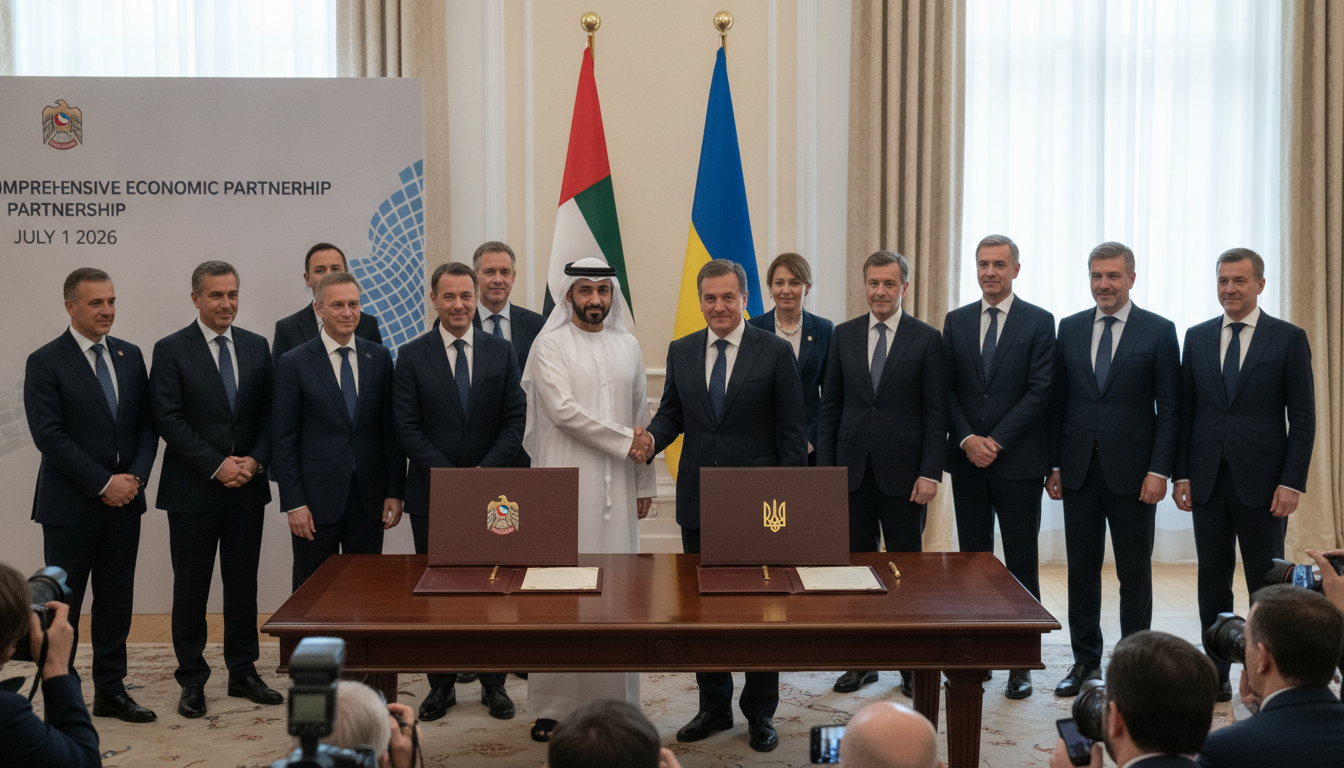
UAE–Ukraine economic partnership agreement enters into force on July 1, 2026
UAE-Ukraine economic partnership agreement takes effect on July 1, 2026, cutting tariffs on most goods and boosting trade, investment and private-sector ties.
The UAE–Ukraine economic partnership agreement officially takes effect on July 1, 2026, opening a new chapter in commercial and investment ties between the two countries. The move will remove or reduce tariffs across a wide range of goods and services and is designed to expand market access for businesses on both sides. Officials say the pact aims to accelerate non-oil trade and create fresh investment corridors linking the Emirates with an important European market.
Agreement Comes Into Force Tomorrow
The comprehensive economic partnership agreement is scheduled to enter into force on July 1, 2026, following completion of ratification procedures. Implementation will activate the tariff schedules and regulatory cooperation mechanisms negotiated by both governments. The formal start date marks a tangible step toward deepening bilateral economic relations.
Tariff Reductions and Immediate Market Access
Under the deal, 99 percent of UAE-origin goods entering Ukraine will receive immediate tariff exemption, while 97 percent of Ukrainian exports to the UAE will be cleared of customs duties at the outset. These near-complete tariff eliminations aim to reduce the cost of trade and simplify market entry for exporters. The agreement also includes provisions to streamline customs procedures and address non-tariff barriers that previously hindered cross-border commerce.
Projected Economic Gains to 2031
Independent feasibility studies cited by officials estimate the pact could add roughly $369 million to the UAE’s GDP and about $874 million to Ukraine’s GDP by 2031. Those projections account for tariff savings, increased export volumes, and expanded investment flows between the two economies. Analysts note that such gains depend on effective implementation, uptake by private-sector firms, and the broader trajectory of global trade.
Trade analysts underscore that the agreement’s economic benefits are expected to accrue gradually as firms adjust supply chains and identify new market opportunities. The 2031 horizon reflects medium-term modelling that anticipates scaling of exports, joint ventures and sectoral cooperation.
Non-Oil Trade Trends and Baseline Figures
Bilateral non-oil trade reached a peak of $904.4 million in 2021 before moderating in subsequent years. By 2025, non-oil trade between the UAE and Ukraine stood at $346.8 million, reflecting shifting global conditions and market disruptions. The new agreement is intended to help recover and expand non-oil exchanges by lowering trade barriers and encouraging diversification of traded goods.
Officials say the pact targets sectors where both markets have complementary strengths, which could help restore trade momentum and push volumes toward or beyond previous highs. Observers caution that external factors, including global commodity cycles and logistical constraints, will shape the pace of recovery.
Private Sector Opportunities and Investment Flows
Business leaders in both countries are expected to benefit from improved market predictability and tariff certainty. The agreement places emphasis on enabling small and medium-sized enterprises and entrepreneurs to scale exports and form cross-border partnerships. Key opportunities cited include food and agribusiness, machinery and equipment, logistics services, and the digital economy.
Investors and corporate groups are also likely to explore joint ventures and presence in free zones, leveraging the UAE’s logistics and finance hubs to access European and regional markets. Trade facilitation measures built into the pact aim to reduce administrative costs and speed up customs clearance for eligible shipments.
Strategic Fit with UAE’s Global Trade Agenda
The UAE has pursued a broad network of trade agreements as part of a strategy to anchor its role as an international commercial hub. To date, the country has negotiated 37 trade agreements, 17 of which have entered into force, forming a foundation for expanded market access. Government officials frame the Ukraine pact as a continuation of that strategy, linking the Emirati private sector with new investment destinations.
Dr. Thani bin Ahmed Al Zeyoudi, Minister of Foreign Trade, described the agreement as a significant milestone that will reactivate commercial flows, open investment windows, and strengthen cooperation in vital sectors. He emphasized that aligning trade and investment strategies will support sustainable growth amid an evolving global economic landscape.
The pact includes commitments to regulatory cooperation, rules of origin, safeguards, and dispute-settlement mechanisms designed to protect exporters and investors. These elements are expected to give businesses greater confidence when planning cross-border operations and longer-term investments.
This agreement positions the UAE and Ukraine to capitalize on complementary economic strengths while reducing the friction that has constrained trade. As implementation proceeds from July 1, 2026, private-sector uptake, logistical readiness and continued government engagement will determine how quickly the projected gains materialize.
