
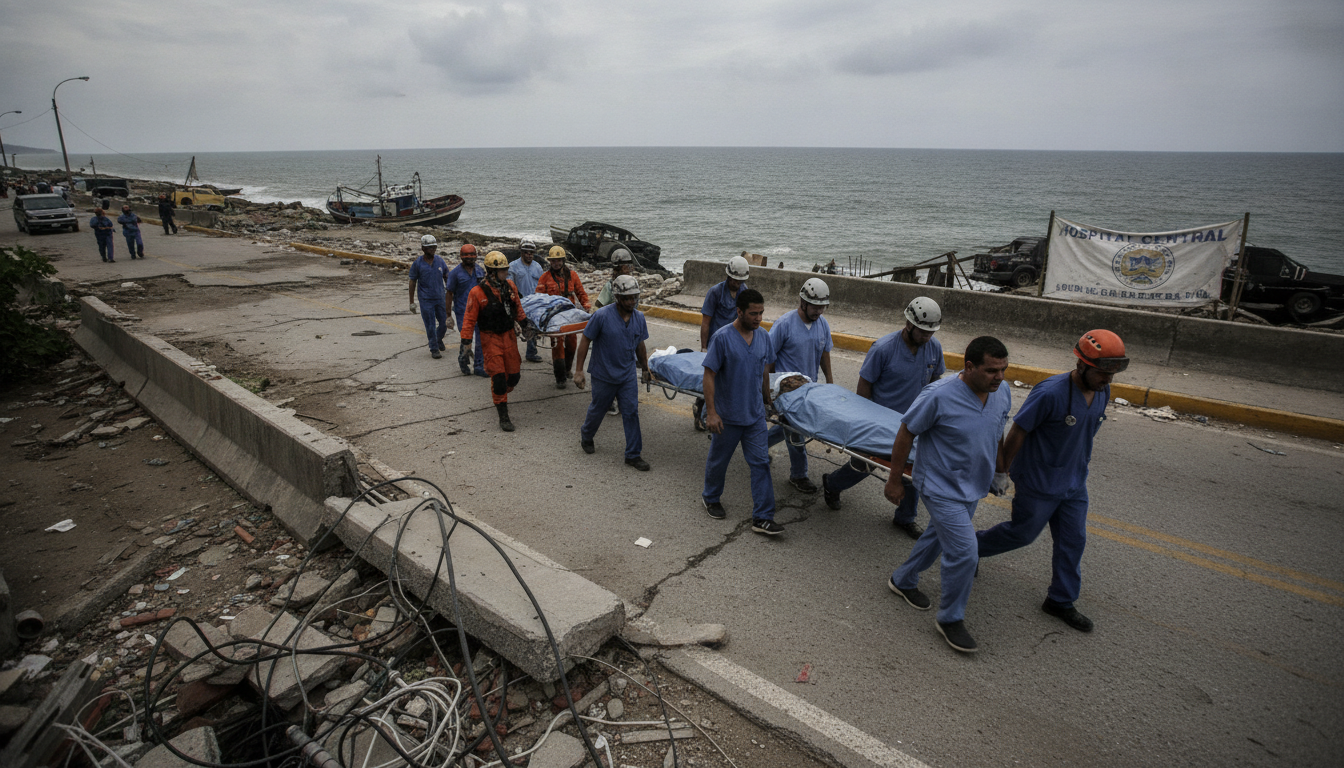
La Guaira earthquake: Caracas doctors race to collapsed Portofino Beach in search-and-recovery mission
Caracas doctors rushed to La Guaira after powerful earthquakes, searching the collapsed Portofino Beach for survivors amid traffic, darkness and tired rescuers.
A team led by Dr. Zaira Medina, director of Pérez de León Hospital in Caracas, drove to La Guaira less than 48 hours after two major quakes struck Venezuela, intending to rescue neighbors and treat the injured. The mission quickly shifted from life-saving to recovery work when emergency teams found no signs of life in the nine-story Portofino Beach building. Volunteers, local emergency services and visiting medical staff faced blocked roads, failing infrastructure and the grim task of recovering bodies amid chaotic conditions.
Medical team mobilizes from Caracas
Dr. Medina assembled a group of physicians and donated supplies and departed for her home state with her daughter, surgeon Gabriela Herrera, accompanying her. They wore scrubs and improvised helmets, loading into multiple vehicles and a pickup truck to reach the coast. What usually is a one-hour drive stretched into four hours as the only highway to La Guaira became congested with evacuees, aid trucks and people carrying water and excavation tools.
Expectations were high that medical teams could find and treat survivors, but the journey set a stark tone: roads jammed with people and supplies, key rescue vehicles stalled, and local hospitals already stretched by the early impact of the quakes. The atmosphere on arrival reflected a rapid shift from emergency care to search-and-recovery operations.
Portofino Beach reduced to rubble
The sand-colored Portofino Beach building, once a mixed-use apartment and vacation tower, suffered catastrophic structural damage that left lower floors buckled and the upper sections leaning precariously. Residents described scenes of collapsed walls, exposed rebar and dense dust, with entire sections of the structure reduced to a pile of debris. Local teams reported a rotting odor at the site, a grim indication that victims were trapped or had perished.
Civil Protection crews established a perimeter and began methodical clearance, but the severity of the collapse made full entry hazardous without heavy lifting equipment and protective gear. An excavation machine was on site but remained unused that evening, a point of frustration for arriving medical volunteers eager to search more aggressively.
Civil Protection signals no signs of life
Germán Ortiz, the Civil Protection official leading the on-site response, told arriving medical staff that his team had detected no calls for help coming from inside the ruin. He urged caution and ordered repeated prompts for any survivors to respond, but silence returned each time. With safety concerns paramount, Civil Protection restricted access to trained rescue personnel with appropriate helmets and breathing protection.
After negotiations, Ortiz allowed the medical volunteers to work at the building’s periphery in rotating teams to avoid exhaustion, but entry into interior voids was denied due to collapse risk. The decision underscored the tension between professional rescuers’ protocols and the urgency felt by neighbors and medical volunteers who had personal ties to the damaged properties.
Search hampered by darkness, logistics and security concerns
As daylight faded, the search operations slowed. The area lacked sufficient mobile lighting and many teams had to pause until daylight returned, forcing exhausted volunteers to withdraw. Traffic congestion had immobilized larger aid convoys, leaving smaller groups, including the Caracas medical contingent, to proceed on foot or in open-bed trucks.
In several neighborhoods teams encountered confusion and sporadic confrontations; reports emerged of people moving in darkness who were later identified as looters rather than trapped survivors. International and regional teams, including Colombian rescue workers, were present and cooperation continued amid the logistical challenges, but the night reduced the ability to locate or extract anyone who might still have been alive.
Doctors pivot to other sites after fruitless hours of searching
Unable to access the building’s core and with the search yielding no rescues, Dr. Medina and her team canvassed nearby structures for other possible victims. They moved methodically through streets that bore the scars of the quake — a church with a sheared façade, collapsed homes and scattered debris. Despite long hours and high hopes, the group returned to Caracas near dawn without having treated any patients during the 12-hour mission.
The experience reflected broader strains on Venezuela’s emergency response: overwhelmed roads, limited heavy equipment deployment, and the sheer number of damaged sites stretching available personnel. Volunteers and medical staff expressed determination to continue supporting relief efforts even as fatigue and emotional strain took their toll.
Final recovery and aid operations will depend on improved coordination, greater access to heavy machinery, and expanded lighting and medical supplies on the ground. In the immediate aftermath, local hospitals, Civil Protection and volunteer networks remain the frontline responders as authorities assess structural damage, tally casualties and organize sustained search-and-recovery missions.
