
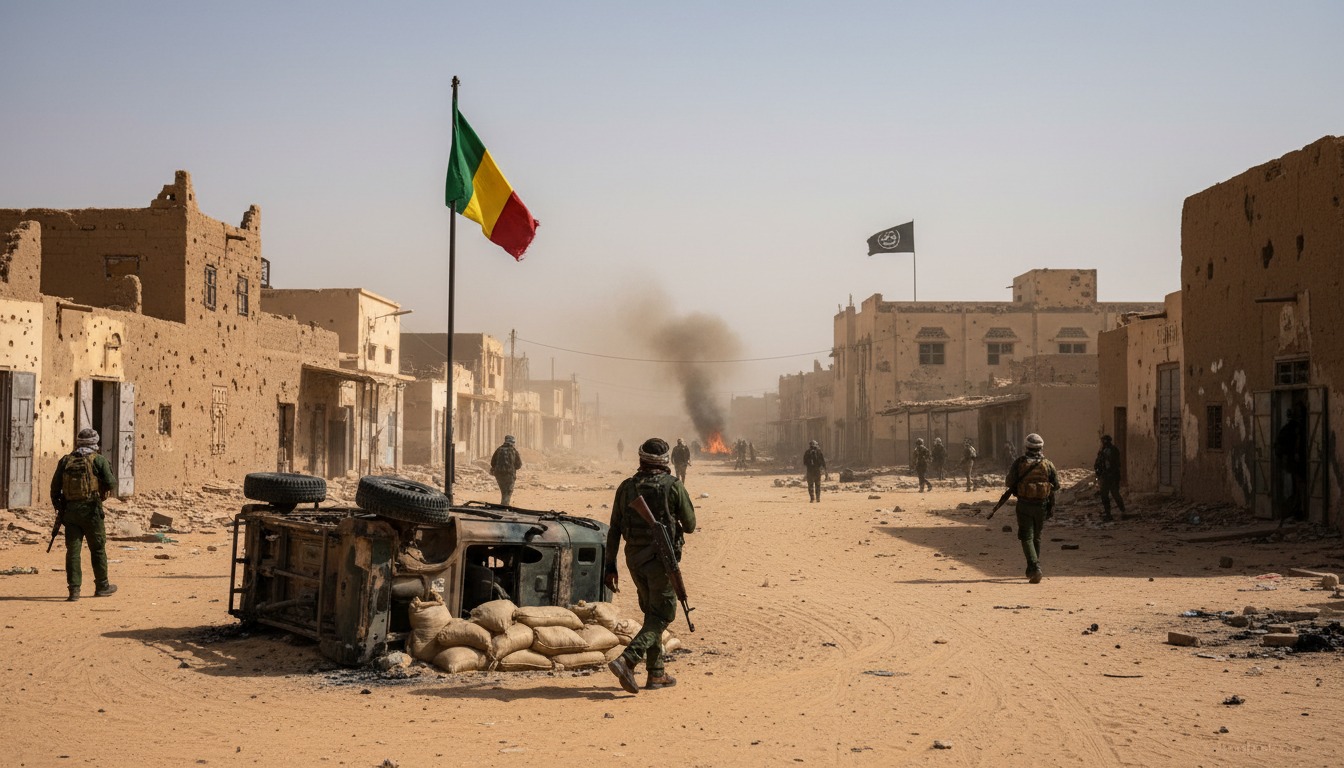
Coordinated attacks in Mali expose security gaps as JNIM and Tuareg FLA seize Kidal
Coordinated attacks in Mali reveal security failures as JNIM and Tuareg FLA seize Kidal and strike military sites, now raising fears of wider instability.
Mali faced a widespread security collapse this weekend after coordinated attacks in Mali targeting military sites and strategic towns exposed deep vulnerabilities in the military-ruled state. The al-Qaeda-linked Jama’at Nusrat al-Islam wal-Muslimin (JNIM) claimed responsibility for strikes in Bamako and northern regions and said it had “captured” the northern city of Kidal with the Azawad Liberation Front (FLA). Analysts and military sources described the operations as unusually broad and sophisticated, penetrating areas long considered secure.
Coordinated attacks reach the capital region and Kidal
A series of near-simultaneous assaults struck military bases, transport routes and urban centres, officials said, unnerving Mali’s political leadership and residents. JNIM announced the operation included a coordinated move with the Tuareg-dominated FLA culminating in the seizure of Kidal in the north. Observers noted the attacks extended into Kati, a military hub near Bamako where senior officials and security installations are located, underlining how far the militants advanced.
Reported high-profile casualty and security leadership blow
A military source told broadcasters that Mali’s Defence Minister, Sadio Camara, was killed during the weekend attacks, a development that would represent a major blow to the junta’s command structure. Confirmation from the government remained limited at the time of reporting, and the military had given few details about casualties or the full scope of damage. The apparent loss of a defence minister will intensify scrutiny of the junta’s ability to maintain order and protect key institutions.
JNIM and FLA’s temporary alignment extends their reach
JNIM, which formed in 2017 from a coalition of jihadist and local armed factions, has been the most active militant group in Mali and the Sahel, according to conflict monitors and security analysts. The FLA, created in 2024 from Tuareg separatist formations, pursues autonomy for the northern Azawad region and has typically clashed with jihadist forces over territory and influence. This weekend’s attacks reflect a pragmatic, if temporary, alignment in which two previously adversarial coalitions coordinated to confront a common enemy—the state and its foreign backers.
History of major strikes and economic disruption
Analysts point to a string of high-impact operations in recent years that eroded public confidence and showcased militant capability. JNIM has been tied to attacks on the Kati military base in 2022 and later strikes that hit Bamako’s airport and an elite police academy in 2024, killing dozens, observers say. The group has also targeted fuel logistics, staging blockades and strikes that halted tanker convoys and choked the capital’s supplies, demonstrating an operational reach beyond remote desert areas.
Russian mercenaries and shifting international involvement
The security vacuum has widened since France and other European contingents withdrew their troops, and Russia-aligned paramilitary forces have stepped into the void under different banners. Wagner personnel formally announced a withdrawal in 2024, yet Russian fighters have remained in Mali under the banner of the Africa Corps, a Kremlin-backed formation created after internal changes within Russia’s paramilitary ranks. The presence of Russian mercenaries has been controversial and has not prevented the recent coordinated assaults, raising questions about the effectiveness and limits of external security partners.
Government response, political fallout and regional diplomacy
President Assimi Goïta’s military government, in power since a 2020 coup, faces urgent domestic and diplomatic challenges as it assesses next steps to retake territory and reassure citizens. Analysts warn the junta must rebuild public trust through clear communications, a coherent security plan and careful navigation of foreign partnerships, including ties with Russia and efforts to engage other African states. Mali’s break from ECOWAS and the creation of the Alliance of Sahel States has complicated regional cooperation, even as Malian officials seek constructive dialogue on trade and movement with neighbours.
International bodies and several governments condemned the attacks and called for restraint, while Mali’s diplomatic engagements have become increasingly complex amid shifting alliances. The African Union, Organisation of Islamic Cooperation and other external actors publicly denounced the violence, and some regional actors signalled limited capacity to intervene given their own security strains. Observers said the Alliance of Sahel States, formed alongside Niger and Burkina Faso, is unlikely to muster substantial military support for Bamako in the short term.
This weekend’s violence underscores that Mali’s security architecture remains fragile and contested, with militant groups capable of synchronised operations that test the limits of a junta reliant on foreign contractors and tenuous domestic backing. Restoring control over towns like Kidal and Kati will require intensified coordination among Mali’s forces, clearer public messaging from the government and contingency planning with regional and international partners to prevent further fragmentation.
