
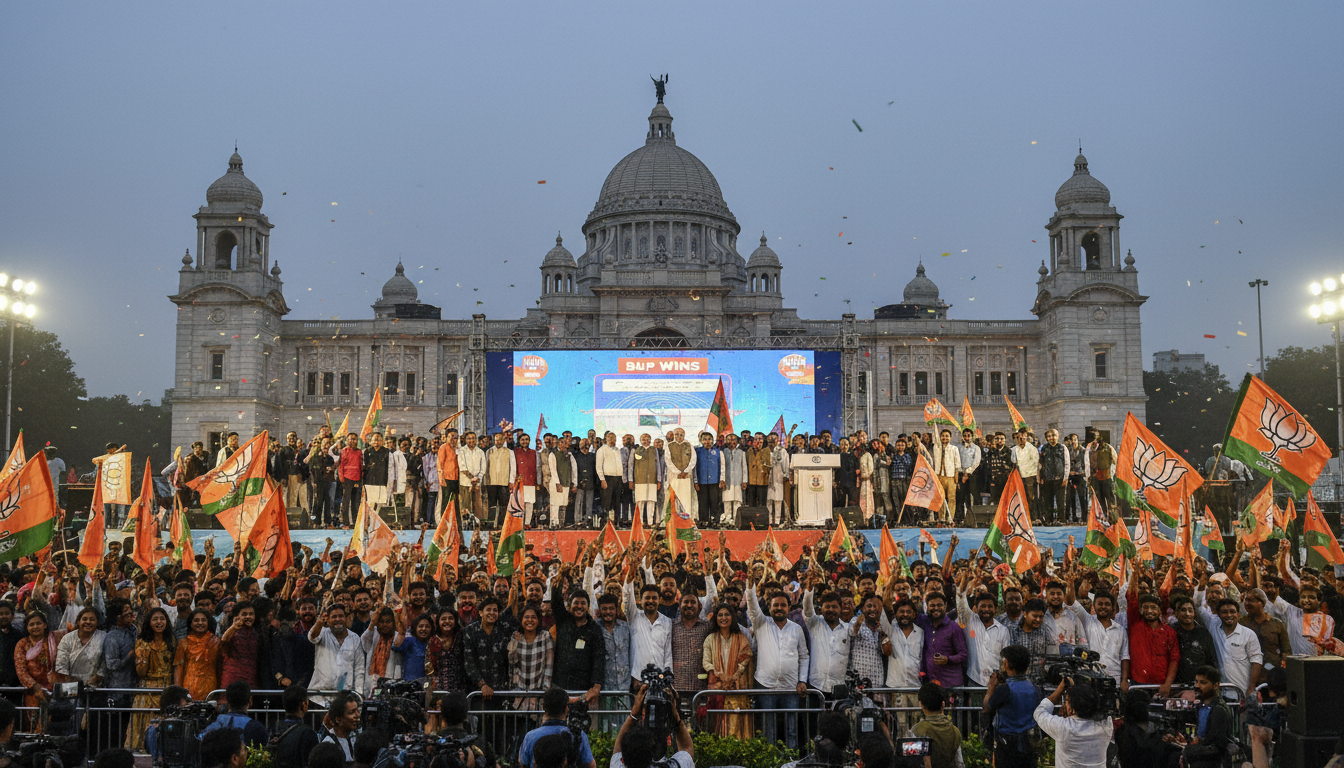
BJP Clinches Historic Win in West Bengal Election, Reshaping Regional and National Politics
BJP’s West Bengal election victory ends Trinamool rule, prompting concern over voter deletions, communal tensions and implications for India’s politics.
The Bharatiya Janata Party (BJP) secured a decisive majority in the West Bengal election, unseating the Trinamool Congress after more than a decade of state rule. The result, favoured by the party’s sustained campaign in the state, marks the BJP’s first outright control of West Bengal since its formation and is being hailed by its leaders as a major landmark. The outcome is already prompting scrutiny of electoral procedures, communal relations and the broader balance of power across India.
BJP majority and electoral maths
The BJP won a clear majority in the 294-seat assembly, reducing the Trinamool Congress to a significantly smaller bloc and delivering a personal defeat to the state’s outgoing chief minister. Party leaders framed the result as validation of their development and governance agenda, while opposition figures attributed the loss to a combination of anti-incumbency and aggressive campaigning. Analysts note that the BJP’s vote share rose sharply over the past decade, transforming it from a marginal player into the dominant force in this election.
Historical context of Bengal politics
West Bengal’s political evolution has been shaped by a long history of anti-colonial politics, communist governance and regional movements, which set the state apart from many other Indian states. The Trinamool Congress displaced a 34-year leftist administration in 2011 and governed through a blend of populist programmes and regional identity politics. The BJP’s breakthrough redraws a political map that for decades balanced ideological currents distinct from the party’s core constituencies.
Contested voter rolls and legal questions
The counting and results have reignited questions about the integrity of the voter register in West Bengal, after a reported removal of a large number of names ahead of polling. Independent researchers and opposition leaders said deletions were disproportionately concentrated in districts with sizable minority populations, a claim that election authorities have denied. Observers and legal experts say such disputes could fuel litigation and parliamentary debate, and underscore demands for transparent review mechanisms in the electoral process.
Communal concerns and daily life in the state
West Bengal is home to a large and diverse Muslim community, and the election has heightened anxieties about communal balance and everyday freedoms. Campaign rhetoric from several BJP figures that highlighted issues of migration and identity has raised fears among minority communities of intensified scrutiny and enforcement actions. At the same time, party officials have publicly pledged to protect cultural practices and livelihoods, stressing that governance will prioritise development and law and order.
Policy direction: lessons from Assam and expectations
Political analysts point to Assam as a likely model for elements of governance the BJP may pursue in West Bengal, given recent precedents in northeastern states. In Assam, measures relating to citizenship documentation and land have provoked controversy and widespread protests, and similar policy tools are now being watched for potential replication. Senior state leaders who campaigned on promises of tighter enforcement against undocumented residents have signalled an intent to pursue administrative measures that they argue will strengthen security and development.
Regional ripple effects beyond Bengal
The state results were part of a larger set of polls that produced notable shifts elsewhere, including the emergence of a new regional power in Tamil Nadu and a return of an opposition coalition in Kerala. In Tamil Nadu, a film actor’s fledgling party made a rapid advance, breaking the long-standing duopoly of Dravidian parties, while Kerala’s electorate returned a Congress-led alliance after a period of communist rule. These outcomes underscore a fragmented and dynamic regional political landscape even as national parties consolidate power in many states.
The West Bengal election will have implications that extend beyond its borders, influencing legislative priorities in New Delhi and altering the strategic calculations of national parties. For voters and civil society in the state, the immediate questions will concern safeguards for electoral fairness, protections for minority communities and how new administration policies will affect everyday life. As legal challenges and political mobilisation unfold in the coming weeks, the result is likely to shape public debate on the health of India’s democratic institutions and the balance between regional autonomy and national governance.
