
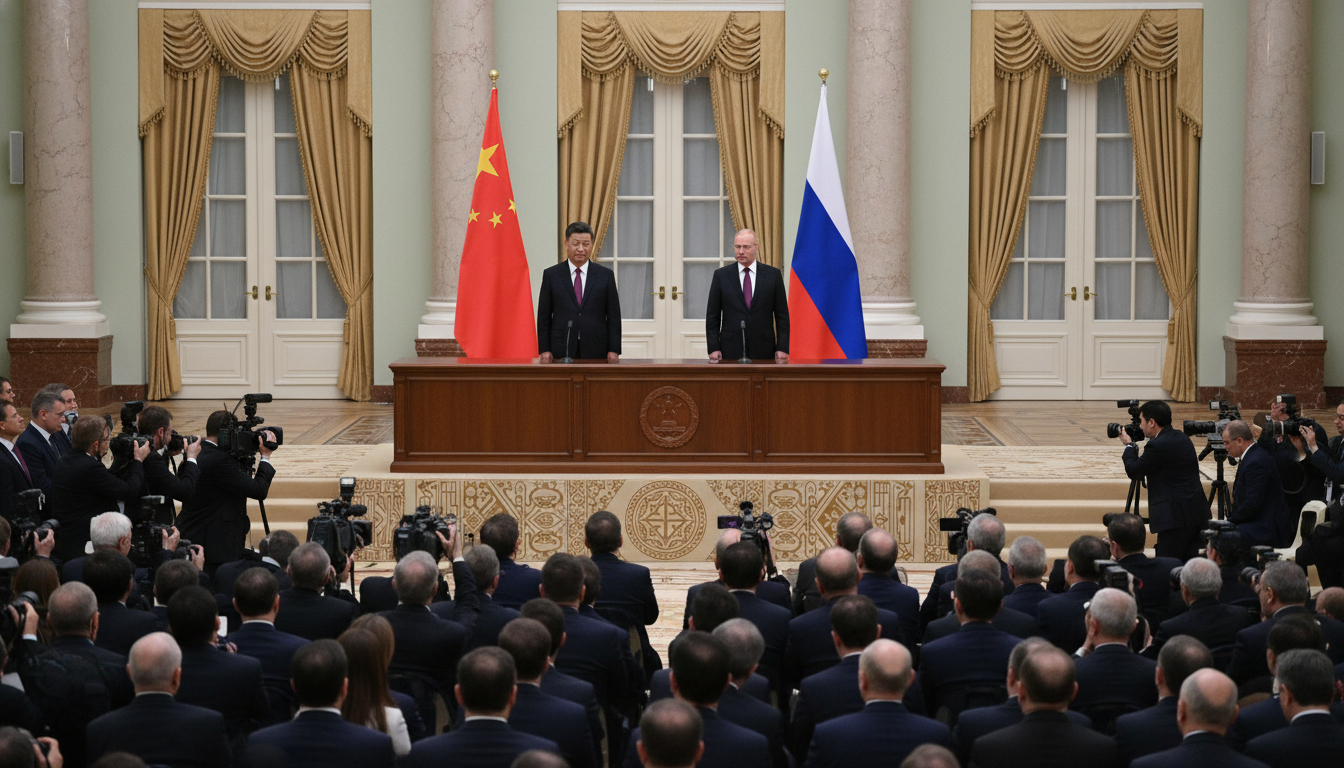
Xi-Putin summit in Beijing frames China and Russia as stabilizing partners amid global turmoil
Xi-Putin summit in Beijing: Xi urged an immediate Middle East cease-fire as leaders deepened China-Russia ties, signing more than 40 documents and debating energy deals.
China’s leader Xi Jinping met with Russian President Vladimir Putin in Beijing on Wednesday in a high-profile summit that framed the Xi-Putin summit in Beijing as a counterweight to global instability and a platform for expanding bilateral cooperation. Xi used the meeting to call for a “complete cessation of hostilities” in the Middle East and warned of the economic risks from renewed fighting. The two leaders presented a united front while negotiating a complex mix of shared interests and strategic asymmetries.
Xi Calls for Cessation of Hostilities
Xi said an early end to the Middle East conflict would help stabilize energy supplies, industrial chains and international trade, according to Chinese state media. He tied China’s economic security to stability in the Strait of Hormuz, noting the waterway’s crucial role for Beijing’s oil imports. The appeal underscored China’s economic stake in regional calm as much as its diplomatic posture.
Beijing’s language also contained an implicit critique of unilateral military actions, a reference observers interpreted as directed at Washington without naming it. Xi warned that renewed fighting would be “unacceptable,” reflecting China’s interest in preventing disruptions that could hit global commerce and its own supply chains.
Display of Deepening China-Russia Partnership
Both leaders used the summit to signal a closer strategic alignment, with Xi describing a new phase of more active engagement and Putin emphasizing coordination of positions. Putin opened his remarks with personal warmth, calling Xi “my dear friend,” and portrayed the relationship as an equal partnership working toward a more just international order. The optics of the day — ceremonial honors and public praise — were intended to show durable ties.
The Kremlin reported the signing of more than 40 documents, capped by a joint declaration promoting a multipolar world and a “new type of international relations.” That rhetoric projects a shared vision of global governance, even as critics point to tensions between those ideals and Moscow’s military actions in Ukraine and Beijing’s assertive regional moves.
Energy, Trade and the Power of Siberia 2 Stalemate
Energy diplomacy was central to the talks, but a major pipeline deal remained unresolved. Putin pressed for the Power of Siberia 2 pipeline to deliver more Russian gas to northwest China via Mongolia, a project that has been stalled over price and dependency concerns. Kremlin officials said nuances still needed agreement, and no contract was signed during the visit.
At the same time, Putin highlighted Russia’s role as a reliable supplier amid the Middle East crisis while praising China as a responsible consumer. With disruptions to oil flows raising prices and jittery markets, both sides have incentives to expand trade and secure energy routes, yet Beijing is wary of becoming overly dependent on a single source.
Technology Dependence and Strategic Asymmetry
Beneath the display of partnership, the summit exposed an uneven balance: Russia’s growing dependence on China for dual-use technologies and economic lifelines. Since Moscow’s broader military engagement that strained its economy and supply chains, Beijing has emerged as an essential source of technology and investment that can sustain Russian capabilities. That dynamic gives China leverage even as the two countries present themselves as equals.
Putin’s entourage included energy executives, underscoring Moscow’s push to consolidate economic ties and secure new markets. For Beijing, the calculus involves securing resources and preserving trade flows while avoiding strategic overreliance on any single partner.
Diplomatic Balancing: Meetings with Trump and Putin
Xi’s reception of both Vladimir Putin and, within days, former U.S. President Donald Trump, illustrated a deliberate diplomatic balancing act. Chinese leaders have courted high-level engagement with Washington even as they reinforce ties with Moscow, seeking to manage friction on tariffs, technology restrictions and sensitive issues such as Taiwan. The contrasting visits — both afforded ceremonial pomp — signaled Beijing’s intent to hedge across major powers.
Russian aides also floated the prospect of Putin and Trump meeting in Shenzhen in November, and suggested U.S. envoys for peace talks might travel to Russia in the near term. Those potential contacts indicate that Beijing, Moscow and Washington remain interconnected despite rhetorical clashes and strategic competition.
Agreements Signed and the ‘Multipolar World’ Declaration
Officials emphasized the summit’s document trove, including a joint declaration on the emergence of a multipolar world and a new type of international relations. The declaration framed China and Russia as proponents of a global order that rejects hegemonic behavior and favors “mutual respect,” language meant to resonate with countries wary of dominance by a single power. Critics argue, however, that the declaration’s principles clash with actions by both capitals.
Kremlin spokesman Dmitri Peskov described outstanding technical details on certain projects, while state announcements celebrated expanded cooperation across trade, energy and diplomacy. The formal agreements were as much political signaling as they were commercially substantive, designed to reinforce the image of a strategic partnership.
Xi’s appeal for regional calm and Putin’s praise for coordinated diplomacy come at a moment of heightened geopolitical friction and economic vulnerability. The summit in Beijing underscored both opportunity and limits: the two governments can amplify each other’s international standing and help cushion economic shocks, yet structural differences and mutual wariness persist.
The outcome of the Xi-Putin summit in Beijing will be judged in coming months by whether concrete agreements — particularly on energy and technology — advance, and whether the leaders’ shared rhetoric translates into sustained cooperation without deepening dependencies that could constrain either side.
