
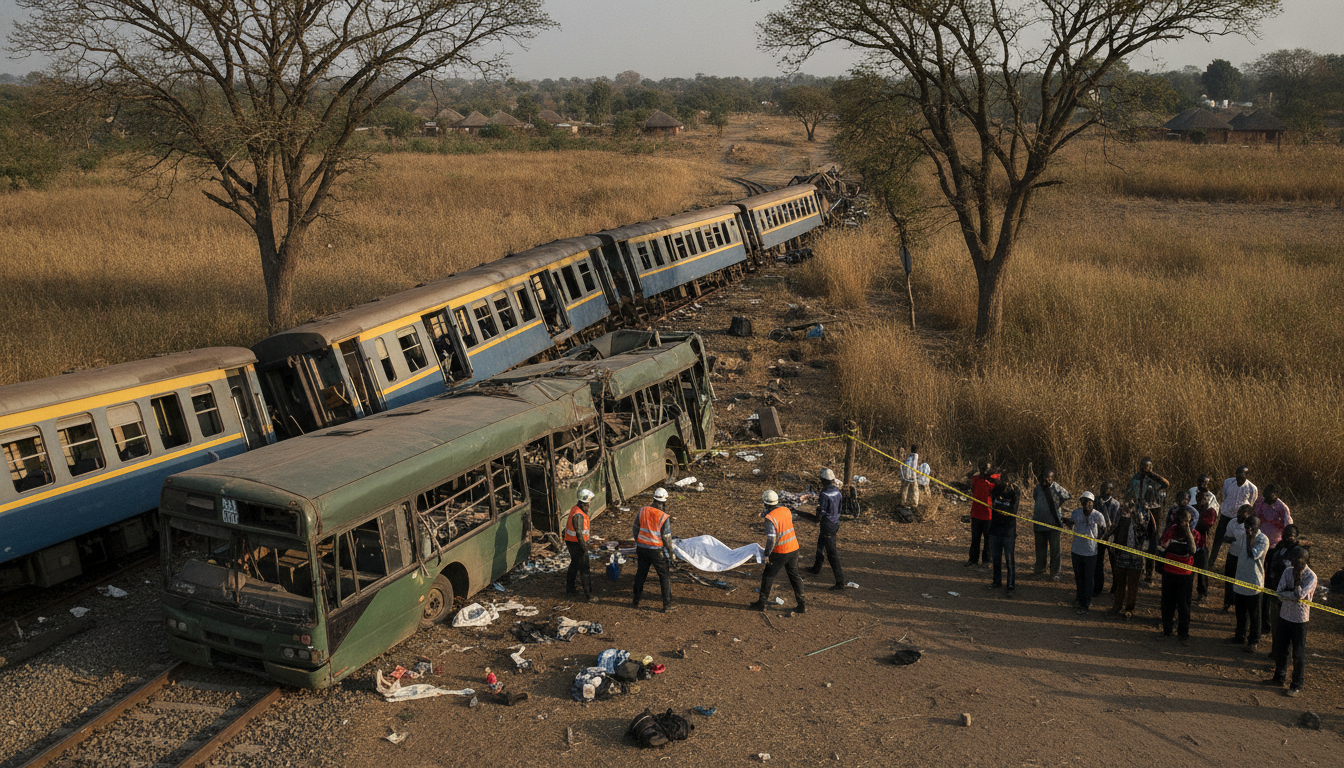
Train-bus collision in Zimbabwe kills nine, injures 25 in Triangle
Nine killed and 25 injured in a train-bus collision in Triangle, Zimbabwe; police say bus failed to stop at the level crossing, raising road safety concerns.
At least nine people, including two children, were killed and 25 others injured after a freight train struck a passenger bus at a level crossing in Triangle, a sugar-producing town in southern Zimbabwe. The collision, confirmed by police and rail authorities, happened when the bus entered the railway line without stopping to check for oncoming trains. Officials said the crash follows a separate deadly bus fire less than a week earlier, intensifying concerns about transport safety across the country.
Casualties and scene at Triangle
Local police and railway officials reported that nine people died at the scene, among them two children, and that dozens more were taken to nearby medical facilities for treatment. Rescue teams and first responders worked to clear wreckage and assist survivors, with ambulances ferrying the injured to hospitals in the area.
Emergency services remained at the site for several hours as investigators documented the collision and recovered the victims. Families in Triangle were left grieving as authorities pieced together the sequence of events that led to the crash.
Rail authority attributes collision to driver breach
Andrew Kanambora, a spokesperson for the national railways, said the bus driver failed to stop and check for approaching trains before crossing, a clear violation of established safety rules. Kanambora’s statement indicated that the bus’s movement onto the tracks directly precipitated the freight train’s fatal impact.
Rail officials stressed that level crossings require strict adherence to stopping procedures to prevent such collisions. They said the incident underscores persistent compliance gaps at numerous crossings nationwide.
Injuries, hospital response and patient status
Authorities reported that at least 25 people were wounded in the collision and received treatment for a range of injuries, from fractures to serious blunt-force trauma. Local hospitals and clinics were mobilised to handle the influx of patients, with medical staff prioritising those in critical condition.
Officials did not immediately release a full list of the injured or a breakdown of their conditions, and family members were still being notified. Health teams continued to monitor patients and provide updates as stabilisation and triage efforts proceeded.
Recent deadly bus fire adds to mounting alarm
The Triangle collision occurred less than a week after a separate incident in central Zimbabwe, where a bus carrying schoolchildren caught fire and claimed seven lives. That tragedy fuelled public outrage and renewed scrutiny of vehicle safety standards and emergency preparedness.
Combined, the two incidents have prompted calls from communities and advocacy groups for immediate action to protect school transport and public buses. Families and local leaders have urged authorities to speed up reforms and enforcement measures to prevent further loss of life.
Road safety data and human error concerns
Zimbabwe’s Road Safety Agency statistics, cited by officials, paint a stark picture of the country’s traffic crisis: road accidents are reported frequently, with the agency estimating an average of one crash every 15 minutes. Those figures translate to roughly five fatalities and 38 injuries per day, the agency says, with human error accounting for approximately 94 percent of incidents.
Experts and road-safety campaigners argue that the prevalence of human error highlights the need for better driver training, public education on crossing protocols, and improved enforcement of traffic laws. They say without systemic changes, fatal collisions at crossings and on highways will likely continue.
Pressure mounts for stronger crossing enforcement
In the wake of the Triangle crash, stakeholders called for faster installation of active safety measures at level crossings, including gates, warning lights and audible alarms. Road and rail authorities face growing demands to prioritise crossings near population centres and schools.
Advocates also urged renewed focus on driver behaviour, recommending targeted awareness campaigns and stricter penalties for violations at rail intersections. Community leaders said coordinated action between transport, rail and police authorities is essential to restore public confidence.
Authorities said investigations into the Triangle collision are ongoing and that they will release further details as enquiries progress. Families of the victims and residents of Triangle have demanded transparency and swift measures to prevent similar tragedies in the future.
