
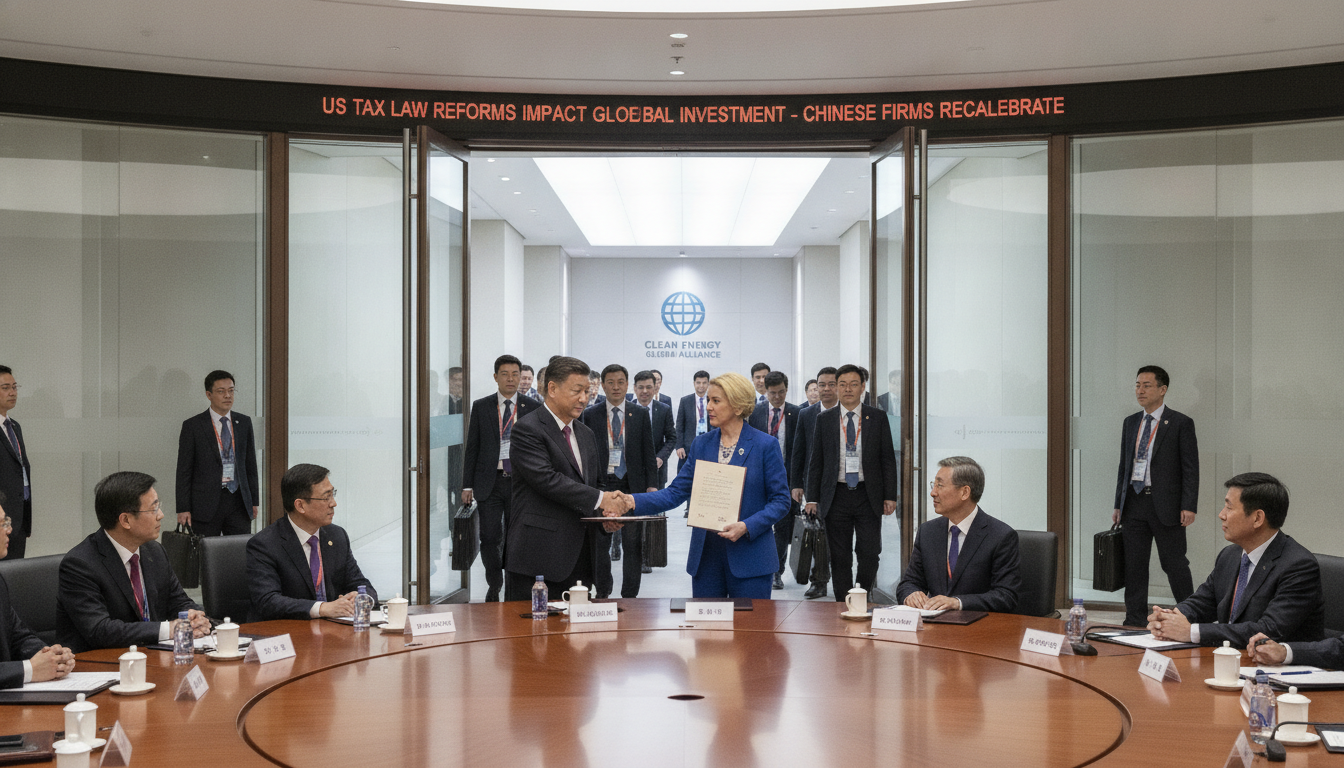
Chinese divestment from the U.S. solar industry accelerates as policy shifts force asset sales
U.S. tax and foreign-ownership rules have driven a wave of Chinese exits from U.S. solar factories, prompting sales, restructurings and new American ownership. (150–160 characters)
Strong opening: Dallas plant sale signals wider trend
The sale of a 5 GW solar module factory near Dallas — built by Trina Solar and transferred into U.S. ownership under T1 Energy — has become emblematic of a broader Chinese divestment from the U.S. solar industry. The Dallas plant, now operating under T1’s G1 Dallas name, reflects a wave of transactions and restructurings tied to recent changes in U.S. tax and foreign-ownership rules. (pv-magazine-usa.com)
Executives at T1 and new U.S. owners present these deals as steps toward domesticising manufacturing capacity and preserving eligibility for federal incentives. Companies that retain ties to Chinese parents have found access to lucrative production and investment tax credits increasingly uncertain under new guidance. (pv-tech.org)
Policy turning point: One Big Beautiful Bill Act and FEOC rules
Congress enacted the One Big Beautiful Bill Act (OBBBA) on July 4, 2025, and the law introduced so-called Foreign Entity of Concern (FEOC) rules that restrict eligibility for several clean-energy tax credits. The provisions make facilities and components ineligible if they receive “material assistance” from a prohibited foreign entity, prompting companies to reassess ownership and sourcing. (bracewell.com)
Treasury and the IRS issued interim guidance in early 2026 to clarify how the FEOC rules apply to Sections 45X, 45Y and 48E credits, including safe harbors for calculating whether material assistance has been provided. That guidance has intensified pressure on factories with Chinese licensing, supply relationships or significant parent-company links. (bakerbotts.com)
Fire-sale prices and restructurings reshape asset ownership
Since the FEOC rules gained traction, several Chinese-built or Chinese-owned U.S. factories have been sold or restructured at steep discounts, according to multiple market accounts. Some deals closed at prices well below construction cost as buyers factored in the loss of tax-credit access for customers sourcing products deemed to have impermissible foreign content. (now.solar)
Boviet Solar’s 3 GW module plant in North Carolina — built under Chinese parent ownership — was publicly disclosed as being sold for roughly $254 million after FEOC rules reduced the asset’s projected value. Market observers say these transactions convert regulatory risk into observable price compression across the sector. (theenergystoragewire.com)
U.S. buyers and strategic acquirers step in
American investors, materials firms and private-equity buyers have moved quickly to acquire affected assets, citing opportunities to secure capacity while meeting domestic-content and ownership tests. Corning’s acquisition of a 2 GW module assembly plant in Arizona and private-equity purchases of controlling stakes in other U.S. facilities are part of this shift toward U.S.-based ownership. (pv-tech.org)
Buyers often combine purchases with new licensing and supply contracts intended to sever effective control by prohibited foreign entities and to qualify for credits or avoid downstream ineligibility. Some Chinese firms have retained minority stakes or restructured intellectual-property arrangements to preserve commercial links while mitigating regulatory exposures. (stocktitan.net)
Supply-chain limits and industrial implications
Despite the reshuffling of ownership, major upstream constraints remain: global polysilicon and much of cell and wafer manufacturing continue to be concentrated outside the United States. That reality means reshoring module assembly does not instantly eliminate dependence on non-U.S. inputs or the technical know‑how embedded in Chinese production lines. (surgepv.com)
Industry participants warn that full decoupling from Chinese supply chains will require years of investment in polysilicon, ingot, wafer and cell capacity and that many buyers are prioritising compliance and tax-credit access over immediate technological independence. Investors who can demonstrate non‑FEOC sourcing chains gain a competitive advantage in a market shaped by incentive eligibility. (bakertilly.com)
What producers and policymakers are planning next
Some U.S. firms are expanding cell and battery fabrication to capture higher-value steps of the solar value chain and to strengthen the domestic content case for credits. T1 and other buyers have announced plans to add cell-making capacity, while private capital groups have signalled investments to scale module output and battery manufacturing in the United States. (pv-tech.org)
Policymakers and market participants now face a delicate balancing act: enforcing national-security and industrial-policy goals without creating abrupt shortages or price spikes that undermine deployment targets for clean energy. Regulatory guidance and the timelines for safe-harbor tables will be closely watched as companies finalize ownership and sourcing decisions. (lexology.com)
The U.S. solar industry’s recent wave of Chinese divestments is both a symptom and a catalyst of change: asset ownership and corporate structures are shifting fast, but the deeper work of building resilient upstream supply chains and domestic advanced manufacturing remains a multi-year task for industry and government alike.
