
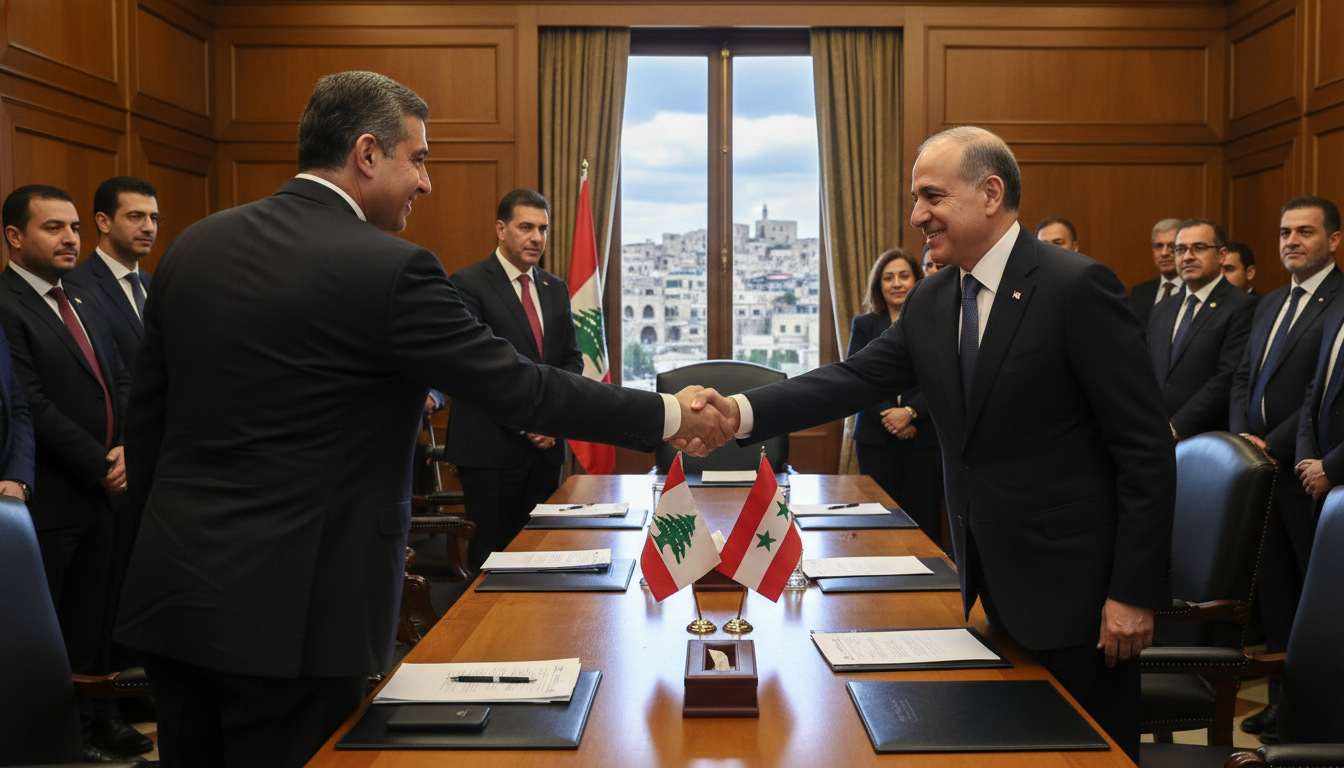
Lebanon-Syria ties take pragmatic turn after Nawaf Salam’s May 9 Damascus visit
Lebanon-Syria ties move toward parity after Prime Minister Nawaf Salam’s May 9 Damascus visit, focusing on prisoner transfers, border control and security.
Lebanon’s Prime Minister Nawaf Salam made a calculated diplomatic trip to Damascus on May 9, marking his second official visit since the fall of the al-Assad regime in 2024 and underscoring a shift in Lebanon-Syria ties. The visit focused on concrete state-to-state issues including detained Syrians, border demarcation and renewed institutional engagement. Officials framed the trip as an effort to normalise relations while both countries face ongoing Israeli attacks and internal security challenges.
Salam’s Damascus visit
The May 9 meeting with Syrian President Ahmed al-Sharaa aimed to reset practical cooperation between the capitals after decades of asymmetric influence. Lebanese statements said discussions covered detained Syrians, missing persons and strengthening bilateral institutions. Analysts view the visit as signifying Damascus’s intent to treat Lebanon as an equal partner rather than a sphere of influence.
Political turning point after al-Assad’s fall
The fall of Bashar al-Assad in December 2024 precipitated a realignment across the Levant and is a central reason for the recent evolution in Lebanon-Syria ties. Syrian politics reordered quickly after December 8, 2024, when al-Assad fled and was replaced by Ahmed al-Sharaa following a military offensive, ending five decades of dynastic rule. The new Syrian government has sought to restore international relations, lift sanctions and distance itself from the alliances that defined the previous era.
Prisoner transfers and border demarcation
One immediate outcome of renewed talks has been progress on detainee issues, a frequent source of bilateral friction. In March, Lebanon transferred 130 Syrian prisoners back to Syria to complete their sentences, though more than 2,000 Syrians remain in Lebanese custody and many have not faced trial. Damascus has made border control, the return of refugees on Syrian terms and recovery of Syrian assets in Lebanese banks central items in its Lebanon agenda.
Hezbollah’s role and security calculations
Hezbollah’s wartime role in Syria and its continuing military capacity remain sensitive topics that both governments have kept off official bilateral agendas. The fall of al-Assad severed or complicated the land routes that once facilitated the transfer of weapons and funds, prompting new security calculations in Beirut and Damascus. Analysts say Damascus is focusing on sealing borders and disrupting smuggling rather than deploying forces to Lebanon, and both capitals appear to prefer informal management of Hezbollah-related tensions.
Israeli operations and regional pressure
Israeli strikes have affected both states and figure prominently in their security discussions, but there is no evidence of a joint Lebanon-Syria strategy against Israel at present. Israel’s operations in Lebanon since March 2 have inflicted heavy civilian casualties and displacement, while Syrian territory has also been repeatedly struck in the year after al-Assad’s removal. Syrian actors and regional analysts accuse Israel of expanding control in southern Syria, a dynamic that adds urgency to Lebanon-Syria talks but also complicates any coordinated response.
Economic and diplomatic priorities
Economic cooperation ranks behind core security and political files despite public attention on energy, gas and transit issues. Damascus prioritises stabilisation, reconstruction funding and reintegration into international diplomacy before pursuing a broader economic agenda with Lebanon. Lebanese officials, meanwhile, are seeking clarification on frozen Syrian deposits and practical measures that could ease long-standing cross-border pressures.
The May 9 visit therefore represents both symbolism and pragmatism: a diplomatic reset intended to address immediate bilateral pain points while acknowledging the limits of what either government can do in the short term. Lebanon-Syria ties are being redefined on equal-state terms, but the pace and scope of cooperation will depend on how each capital manages domestic stabilisation, the Hezbollah question and ongoing Israeli pressures.
