
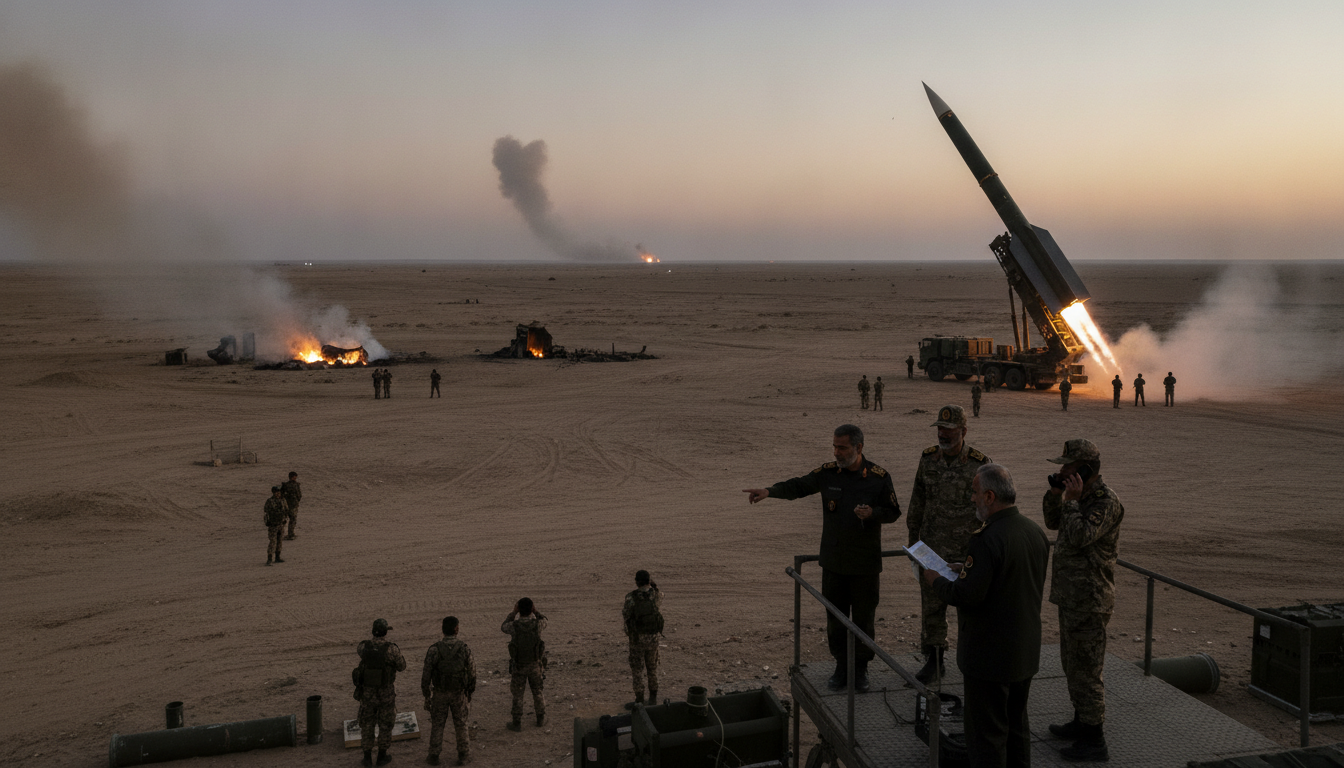
Iran missile strikes on Israel aimed at restoring deterrence, expert says
Iran missile strikes on Israel are intended to restore deterrence without sparking full-scale war, analysts warn amid rising regional tensions.
Renewed strikes and expert assessment
On June 7, 2026, analysts reported a renewed round of Iran missile strikes on Israel that Tehran appears to be calibrating to send a strategic message rather than to provoke an all-out conflict.
Ross Harrison, a senior fellow at the Middle East Institute, said the strikes are meant to restore deterrence while avoiding escalation into full-scale war.
The assessment frames the latest exchanges as a deliberate use of limited force to alter the regional balance of perceptions about vulnerability and resolve.
Analysts caution that this approach raises the risk of miscalculation even when neither side seeks wider hostilities.
How deterrence, not total war, fits Tehran’s calculus
Iran’s choice to pursue missile strikes fits a classic deterrence logic: demonstrate capability and willingness to impose costs while keeping strikes below the threshold that would compel massive retaliation.
Experts point out that such calibrated signaling can satisfy domestic political imperatives in Tehran while pressuring Israel and its partners to reassess hostile options.
Harrison and other analysts note that the strategy relies on ambiguity — limited attacks that communicate capability without providing a clear casus belli for a sweeping military response.
That ambiguity, however, also increases the likelihood that a single incident or a misinterpreted intercept could rapidly widen the confrontation.
Regional security implications and risks of spillover
The restoration of deterrence through missile strikes carries direct implications for regional security dynamics, including airspace safety, maritime routes and the posture of proxy actors.
Even restrained attacks can produce ripple effects, prompting mobilization, heightened alerts and reciprocal moves by allied networks and non-state proxies.
Military planners in the region will be monitoring indicators that signal escalation, such as increases in sortie rates, air-defense activations and pre-positioning of forces.
Diplomats warn that the more actors drawn into the cycle of reprisals and counter-reprisals, the harder it becomes to contain violence within limited parameters.
International responses and diplomatic pressure
International actors are likely to press for de-escalation while reiterating support for the self-defence rights of states under attack.
Governments and regional organizations traditionally call for restraint and urge immediate diplomatic engagement to prevent further deterioration.
Analysts say diplomatic channels, back-channel communications and third-party mediation become especially important when military actions are narrowly calibrated to avoid a broader war.
Such tracks can provide safety valves, offering face-saving mechanisms and pathways for negotiated pauses without forcing either side to abandon their strategic aims entirely.
Military and technological factors shaping the campaign
The conduct of missile operations and defensive countermeasures reflects advances in both offensive reach and layered air-defence systems.
States on the receiving end of attacks increasingly rely on integrated sensors, interceptor batteries and early-warning networks to limit damage and signal resolve.
These technological developments change the cost calculus for limited strikes: precision and stand-off reach allow an attacker to threaten symbolic or material targets, while stronger defences reduce the political returns of high-risk operations.
Analysts suggest that Tehran’s use of missiles in a measured way reflects an understanding of both its capabilities and the constraining effect of modern defences.
Indicators to watch in coming days
Observers list several clear signs to monitor for either escalation or de-escalation.
Key indicators include frequency and geographic spread of strikes, public posture and military movements by Israel, and activity by allied actors and proxies across the region.
Diplomatic exchanges, particularly contact between Washington, Tehran and regional capitals, will be critical to assess intentions and test whether avenues for restraint are functioning.
Economic measures, public statements by military officials and the level of readiness at air bases will also offer visible clues about how close either side is to widening the confrontation.
Public safety and civilian impact will remain central to international concern as the situation evolves, with humanitarian organisations and regional authorities tracking displacement and infrastructure disruptions.
Humanitarian and legal considerations shape both international responses and the domestic politics that influence decision-making.
The renewed strikes on June 7, 2026, underscore the fragile balance between signalling strength and avoiding catastrophe, and analysts caution that carefully measured steps by Tehran could nonetheless spark unintended consequences without robust diplomatic management.
