
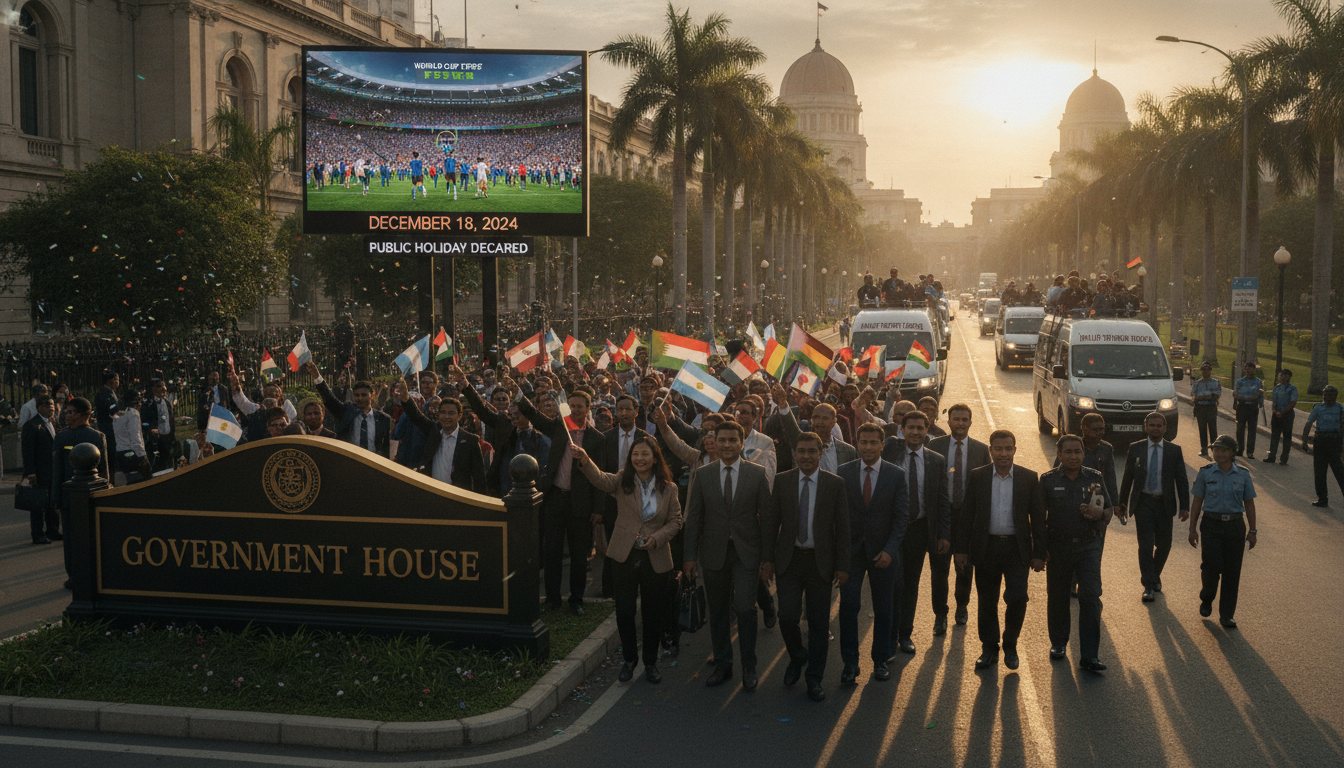
World Cup prompts governments worldwide to alter holidays, transport and opening hours for fans
Governments alter holidays, transport and hours to accommodate World Cup fans, from South American national holidays to overnight Sydney metro services.
As the World Cup advances into knockout rounds, governments from Quito to London are temporarily rewriting public schedules to let supporters watch matches live. South American presidents have declared national holidays after surprise results, while transport and hospitality rules in cities such as Sydney and London have been adjusted for overnight kickoffs. Authorities say the moves balance public enthusiasm with safety and economic opportunity.
Ecuador and Paraguay declare national holidays
After unexpected group-stage victories against a European powerhouse, Ecuador’s leadership announced a day of national celebration to mark the team’s triumph. The presidential statement framed the holiday as recognition of the squad’s achievement and the morale boost it delivered to the country.
Days later, Paraguay followed with a similar decree after advancing past the same opponent in a penalty shootout. Officials described the holiday as a unifying moment, underscoring how football results can prompt immediate national responses across the region.
Sydney keeps metro services running through early-morning kickoffs
In Sydney, state transport authorities confirmed that metro lines would run overnight to accommodate fans watching early-morning matches. The decision was presented as an extension of existing late-night service plans, with additional trains slated to manage expected crowds.
New South Wales officials characterized the measure as part public-service and part crowd-management, aiming to reduce pressure on road traffic and licensed venues while ensuring fans can travel safely after all-night viewings.
United Kingdom extends pub hours and marks Scotland’s return
In the UK, national and regional responses have included relaxed licensing rules and targeted public holidays. The monarch approved a public holiday in Scotland to celebrate the national team’s first World Cup appearance since 1998, a move framed as recognition of a historic sporting milestone.
Meanwhile, the government permitted pubs to remain open past their usual closing times for key fixtures, extending hours into the early morning to support hospitality venues and offer communal viewing opportunities. Officials argued the change would both bolster local businesses and provide supervised spaces for fans.
Schools, unions and coaching staff debate attendance policies
The surge of late kickoffs has reignited debate over school attendance and workplace expectations the day after marquee matches. Teachers’ representatives said schools should be given flexibility if pupil attendance drops following late-night viewings, requesting that institutions not be penalized for lower turnout.
Coaching staff and public figures encouraged families to let children watch important games, prompting education ministers to stop short of mandating closures. Ministers emphasized parental discretion while urging schools to maintain normal sessions whenever possible.
Time zones and knockout scheduling force ad hoc policy changes
Organisers’ scheduling and global time differences have produced a patchwork of government responses, particularly as knockout fixtures shift to awkward local hours. Nations whose supporters face live kickoffs in the small hours have opted for targeted, short-term measures rather than sweeping reforms.
Officials in several countries cited the need to balance public enthusiasm with safety and continuity of essential services, adapting curfews, transport timetables and licensing rules on a case-by-case basis as the tournament calendar evolves.
Economic opportunities and public-order trade-offs shape decisions
Local administrations have highlighted potential economic upsides for hospitality, retail and transport sectors from extended openings and extra services. Industry groups welcomed relaxed rules as a way to capture spending that might otherwise occur in informal or unsupervised settings.
At the same time, police and municipal authorities signalled the need for extra planning around late-night crowds, warning that temporary freedoms require increased resource deployment to manage noise, public safety and transit flows. Officials said contingency arrangements, such as additional staff and clearer messaging, are crucial when normal policies are suspended.
The World Cup’s global pull is reshaping short-term public policy in diverse jurisdictions, with leaders weighing civic pride and economic gains against operational and safety challenges. As the tournament progresses, expect further ad hoc adjustments from governments seeking to accommodate fans while keeping public services running.
